
The Complete Guide to Rouen: The City of a Hundred Spires
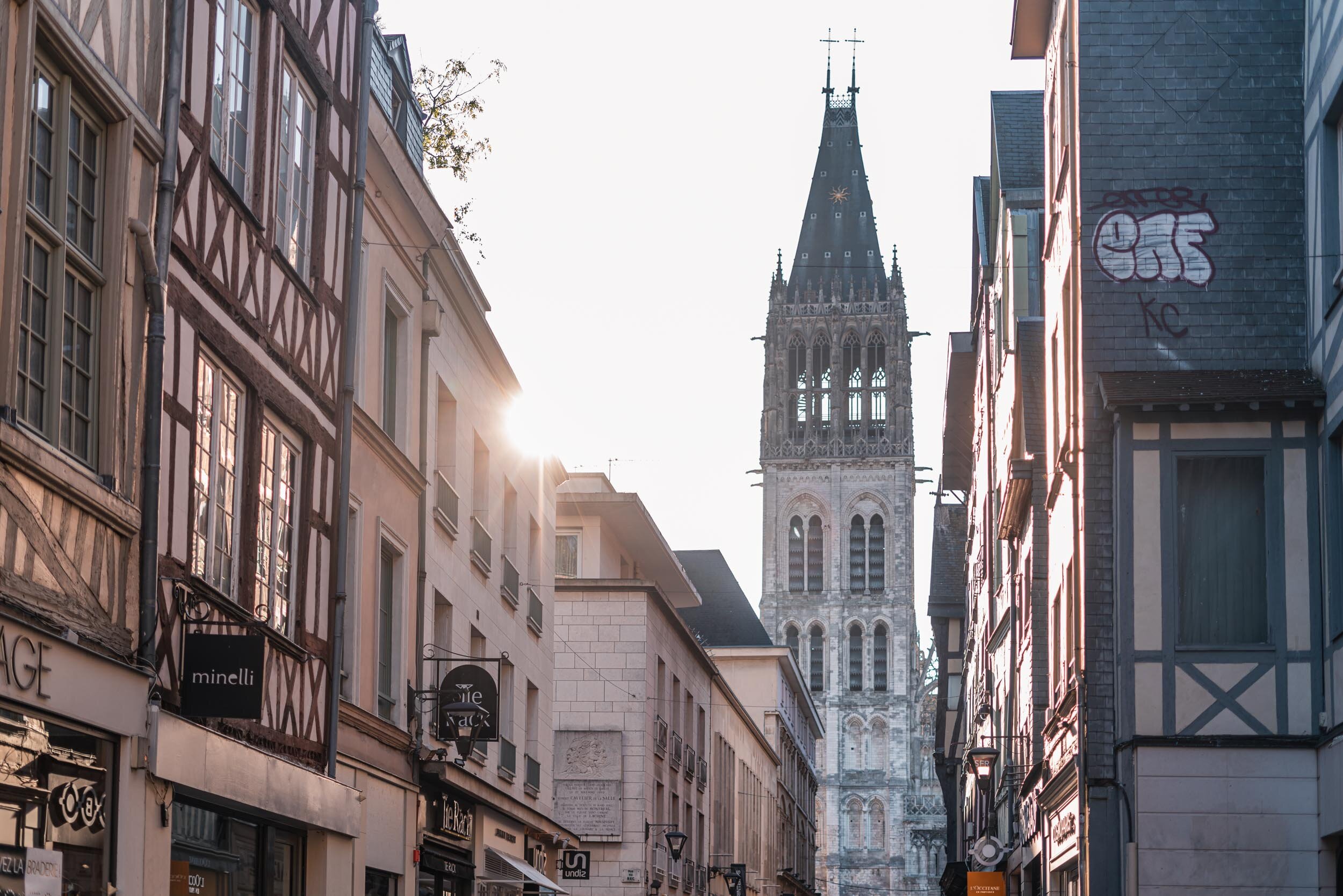
Rouen is the kind of place that makes you wonder why everyone’s still cramming into Paris. Draped along the banks of the River Seine, this port city is the lively capital of Normandy and sits just 1.5 hours from Paris by train – close enough for an easy day trip, tempting enough to warrant far longer.
In the Middle Ages, Rouen built its fortune on the Seine’s river traffic and a booming textile and wool trade. Its coat of arms, emblazoned with a Paschal Lamb, nods to its agricultural roots, while its streets quietly whisper of merchants, monks and monarchs who have all passed through. Then there’s Joan of Arc – the teenage heroine-turned-saint whose trial and execution in Rouen’s market square sealed the city’s place in French history and collective memory.
Victor Hugo christened Rouen “the city of a hundred spires”, and he wasn’t being dramatic. Gothic churches pierce the skyline at every turn, their stone lacework and stained glass rising above crooked half-timbered houses and cobbled lanes. Despite heavy bombing in World War II, the city has painstakingly restored its historic heart, resulting in a rare combination of lived-in charm and museum-worthy architecture.
Today, Rouen holds the second-highest number of listed monuments in France after Paris, yet it feels far less performative, more like a working city that just happens to be absurdly good-looking. It’s a place where you can spend the morning tracing medieval legends, the afternoon hunting down Impressionist views along the Seine, and the evening lingering over Norman specialities as the cathedral lights up for the night.

Getting to and Around Rouen
By Train
The fastest and most civilised way to arrive is by train. Direct SNCF services run frequently from Paris Gare Saint-Lazare to Rouen Rive Droite, taking around 1.5 hours. It’s an easy there-and-back day trip, but also relaxed enough for a longer, slower stay.
If you book ahead, one-way fares can be very reasonable; leave it to the last minute, and prices climb as the train fills up. Commuters from Normandy flood into Paris on weekday mornings and head home in the late afternoon, so try to avoid those peak hours if you prefer a quieter carriage (going the opposite way at rush hour is usually fine).
By Bus
Long-distance buses between Paris and Rouen are often the most budget-friendly option and only slightly slower than the train. The catch? Paris coach stations are usually less central than Saint-Lazare, so double-check the departure station before you smugly congratulate yourself on your savings.
Rouen’s public transport has had a modern facelift, and the Astuce network now links most of the city with buses, trams and even a river shuttle. Tickets are generally valid for one hour from validation on buses and the tramway, so you can hop on and off within that window. The star of the show: buses and trams are free on Saturdays, the perfect excuse to explore more far-flung corners of the city without watching the meter.
By Tram
Astuce operates four tram lines and one metro line, which is essentially a tram that dives underground in the centre before re-emerging as if nothing ever happened.
T1 (red) – Mont aux Malades ↔ Boulingrin
T2 (green) – Marie v Schœlcher ↔ Tamarelle
T3 (purple) – Bizet ↔ Darécu
T4 (yellow) – Boulingrin ↔ Zénith – Parc Expo
Metro (blue) – Boulingrin ↔ Georges Braque / Technopôle
The first three tram lines run north of the Seine, while the metro and T4 continue to the south bank. On Saturdays, the trams join the “free ride” party too, so you can glide between neighbourhoods at absolutely no cost.
By River Shuttle
For something a little more whimsical, Rouen has the Calypso river shuttle, a solar-powered boat that’s part of the Astuce network.
On the western edge of town, it usually sails between Pasteur Pontoon (right bank) and Building 107 (left bank). On hockey nights, it instead connects Quai du Pré aux Loups with the Lacroix Island Ice Rink. The Pasteur tram/bus stop is a two‑minute walk from the pontoon and is served by lines T1, T2 and T3, making it easy to slot into your day.
There are no ticket sales on board, so sort your ticket before you rock up to the pontoon. Weekend crossings are free, but you still need a validated transport ticket in your pocket (no journeys are deducted; it’s more of a formality).
By Bicycle
If you prefer your sightseeing with a side of cardio, Rouen’s self-service bikes, Lovélo, are hard to miss – look out for the raspberry-coloured hoops dotted around the city. You’ll need the Lovélo app to unlock a bike, then you’re free to pedal between cafés, churches and the Seine.
Each pass includes 30 minutes of free riding per trip, then it’s €1 per extra 30 minutes. Day passes and annual subscriptions are available for heavy users. It’s ideal for short hops between sights, with around 60 stations spread across town.
By Car
Can you drive to Rouen? Absolutely. Should you? That depends on your patience.
From Paris, driving takes roughly two hours, and by the time you’ve added tolls, fuel, traffic and parking, it’s usually more expensive – and far less relaxing – than hopping on a train.
However, if you’re already on a Normandy road trip, bringing a car can make sense and let you stop in smaller towns along the way. Just remember, most French motorways are toll roads. You’ll take a ticket when you enter and pay when you exit. Don’t rely solely on foreign cards; it’s wise to have some euros in cash on hand.
Like many historic French cities, Rouen has an old town that isn’t exactly car‑friendly. To keep congestion in check, the city offers park‑and‑ride (P+R) car parks on the outskirts, close to tram and bus stops. Some are free; others become free once you validate a tram or bus ticket at the exit.
What to See and Do
Rouen Cathedral (Cathédrale Primatiale Notre-Dame de l'Assomption de Rouen)
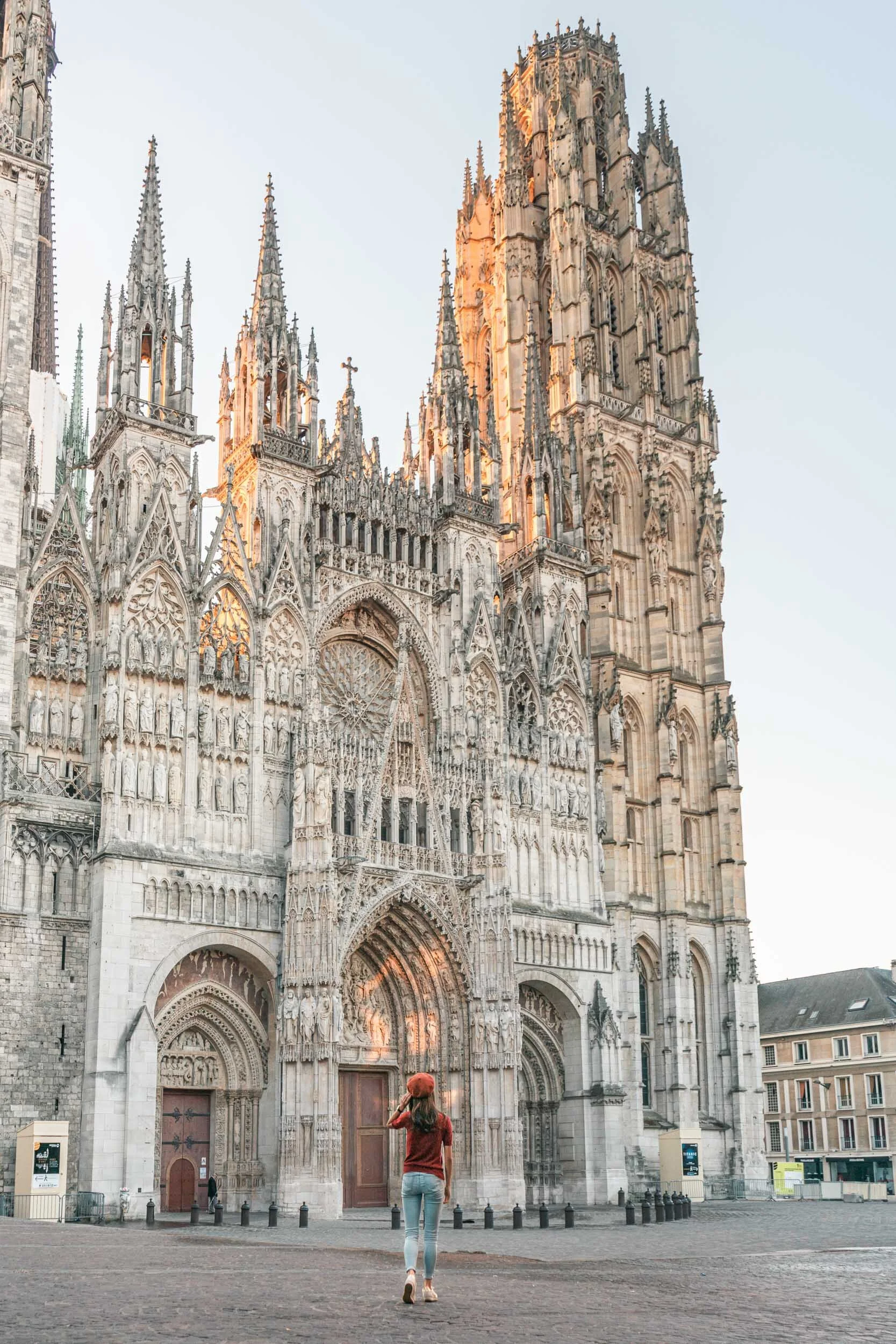

Rouen Cathedral is the drama queen of Normandy – and she knows it. Rising in the middle of the old town, this soaring Gothic masterpiece has been built, burned, bombed and rebuilt over eight centuries, layering Gothic, Flamboyant, and Renaissance details into one gloriously over-the-top facade that barely fits in a photograph.


Its three mismatched towers are part of the charm: the St Romain Tower, with its Gothic core and Flamboyant top tier, houses the bourdon bell “Joan of Arc” and one of France’s largest carillons; the Butter Tower (tour de beurre) was funded by indulgences allowing the faithful to eat butter in Lent; and the central lantern tower rises to an iron spire, making Rouen Cathedral, at 151 metres, the tallest in France.

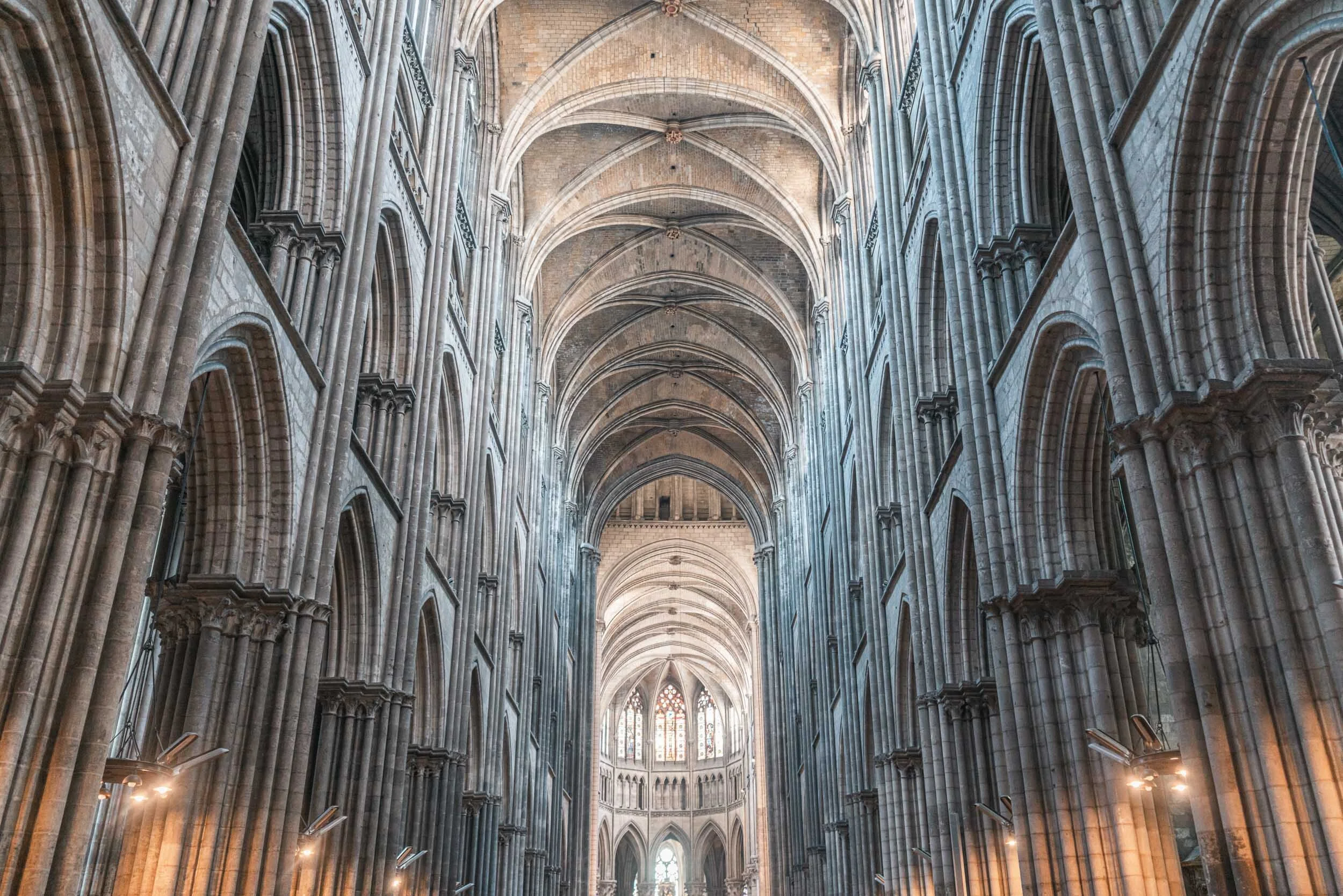
Inside, it’s all soaring vaults, stone lacework and shafts of light – the kind of space that swallows noise and replaces it with goosebumps. The cathedral also guards the heart of Richard the Lionheart, tucked into a tomb like a perfectly normal thing to do with a king’s internal organs.
Claude Monet was obsessed, painting the western front over 30 times in different lights and seasons, cementing the cathedral’s status as an Impressionist icon. In summer, a nightly sound-and-light show washes the facade in colour and storytelling; the square fills with locals and tourists, utterly spellbound.
Le Gros Horloge
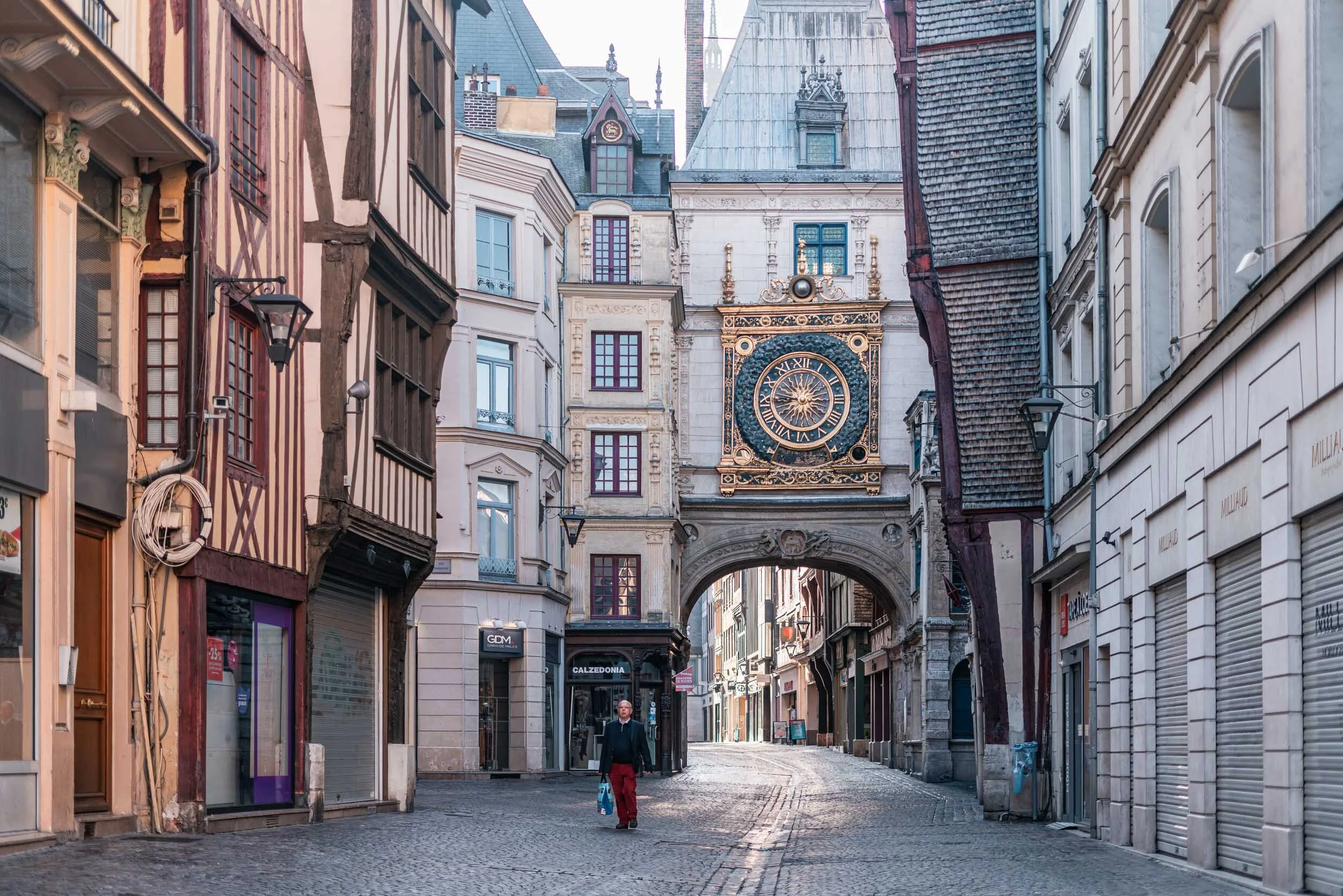
Le Gros Horloge is Rouen’s glittering showpiece – part clock, part archway, part theatrical backdrop to the city’s main shopping street. Translating to “the big clock”, this gilded astronomical timekeeper has presided over Rue du Gros-Horloge since the 16th century, its dial stretching a dramatic 2.5 metres across. You don’t so much “spot” it as walk straight into its orbit.


The clock’s movement dates back to the 14th century, making it one of Europe’s oldest working mechanisms. Originally housed in the adjacent belfry without a dial, it was later moved onto the Renaissance arch. Today, twin faces on either side display a golden sun with 24 rays against a deep blue sky scattered with stars. Above, a small oculus tracks the phases of the moon; below, a panel marks the days of the week with planets and a very self-assured Apollo. The clock completes a full celestial rotation every 29 days, quietly reminding you that time is more than just minutes and meetings.
Look closely at the arch, and you’ll spot Rouen’s Paschal Lamb crest, flanked by two angels – one with a suspiciously odd head, allegedly a stony act of protest by disgruntled workers.


Inside, the former belfry is more intimate than grand, with exhibits on the clock’s history and the craft of timekeeping. The real thrill, though, is the climb: narrow, twisting stairways, stone worn smooth under your hands, and then an open-air viewing platform with panoramic views over Rouen’s rooftops and spires. It’s not particularly high, but because the surrounding buildings are low-rise, the city spills out beneath you in all directions. If, like me, you’re unable to resist any structure with steps and a view, go early when it opens – fewer people to squeeze past and more time to pretend you own the town.


Tracing the Story of St Joan of Arc
Church of St Joan of Arc (Eglise Sainte Jeanne d’Arc)

The Church of St Joan of Arc is Rouen’s boldest plot twist: a strikingly modern church set in the middle of the old market square, the very square where Joan of Arc was burned at the stake in 1431. Joan of Arc is famous for leading French forces to victory during the Hundred Years' War and for her subsequent martyrdom, making her a legendary and inspiring figure. The church functions as both a memorial and a statement piece, refusing to let her story fade into pretty, distant history.

Designed by Louis Arretche in the 1970s, the building is all sweeping curves and sharp angles, best understood by circling it slowly, like a curious cat. Its undulating roofline has been read as flames rising from the pyre, an overturned Viking‑style longship, and even fish and boats echoed in the adjoining market halls – all rich in Christian symbolism. The scaled tiles and almost Nordic profile feel unusually maritime for a church, as if it’s half ready to sail down the Seine.


Inside, the space feels intimate and contemplative rather than grand. Heavy wooden beams continue the “inverted ship” theme, drawing your eye upwards, but the real showstopper is the stained‑glass wall: 16th‑century windows rescued from the bombed Church of St Vincent and reassembled here. Thirteen glowing panels depict scenes from the life of Christ and various saints, washing the interior in soft, coloured light that’s quietly devastating in its beauty.


Just outside, a modest garden to the north holds Le Bûcher – a simple marker indicating the spot where Joan was executed. Under the walkway, an inscription honours her as a heroine “without tomb and without portrait”, and a plaque from “the grateful French people” underlines how deeply she’s woven into the national psyche.
Visiting the church felt extra special because Joan of Arc is one of the few books I studied in English literature. And standing here, with market chatter on one side and this sculptural church on the other, Joan’s story suddenly feels very close – less myth, more raw memory anchored to a specific square of cobbles.
Joan of Arc Historial (Historial Jeanne d’Arc)
Tucked behind the cathedral in the former Archepiscopal Palace, the Joan of Arc Historial brings the legend to life, stepping out of stained glass and into full-blown immersive theatre. Housed in the historic seat of Rouen’s archbishops, it feels solemn before the tech kicks in: a multimedia, trial‑style experience that walks you through Joan’s life, condemnation and posthumous rehabilitation, using projections, testimonies and atmospheric sound.
The show is in French, but English audio guides are available (highly recommended unless your legal French is suspiciously strong). Don’t skip the upper levels – the rooftop views over Rouen are a quiet little bonus.
Tower of Joan of Arc (Tour Jeanne d'Arc)
The Tower of Joan of Arc (Tour Jeanne d’Arc) sits slightly north-west of the historic centre, a solid cylindrical stone stump that’s all that remains of Philippe Auguste’s 13th‑century castle. Once the donjon, it’s here that Joan of Arc was interrogated and threatened with torture – a chilling thought when you step inside its thick walls.
Today, the tower hosts guided visits and a surprisingly fun escape game themed around the 15th‑century siege of Rouen. It’s an odd but compelling mix: sombre history, stark medieval architecture and modern storytelling, all rolled into one atmospheric stone cylinder.
Joan of Arc Monument (Monument Jeanne d'Arc)
The Joan of Arc Monument stands on St Catherine's Hill above Rouen, near the famous viewpoint overlooking the Seine and the cathedral. This modern stone column and statue mark Joan’s martyrdom in the city below, offering a quiet, contemplative counterpoint to the dramatic panorama and a natural complement to the nearby lookout terrace.
Abbey of St Ouen (Abbatiale Saint-Ouen)


The Abbey of St Ouen feels like Rouen’s best-kept secret: a church that would be the headline act in almost any other French city, yet here quietly shares the stage with the cathedral. Just east of the historic centre and wrapped in leafy gardens now belonging to City Hall, it’s named after St Ouen, Rouen’s 7th‑century bishop, who is buried here.

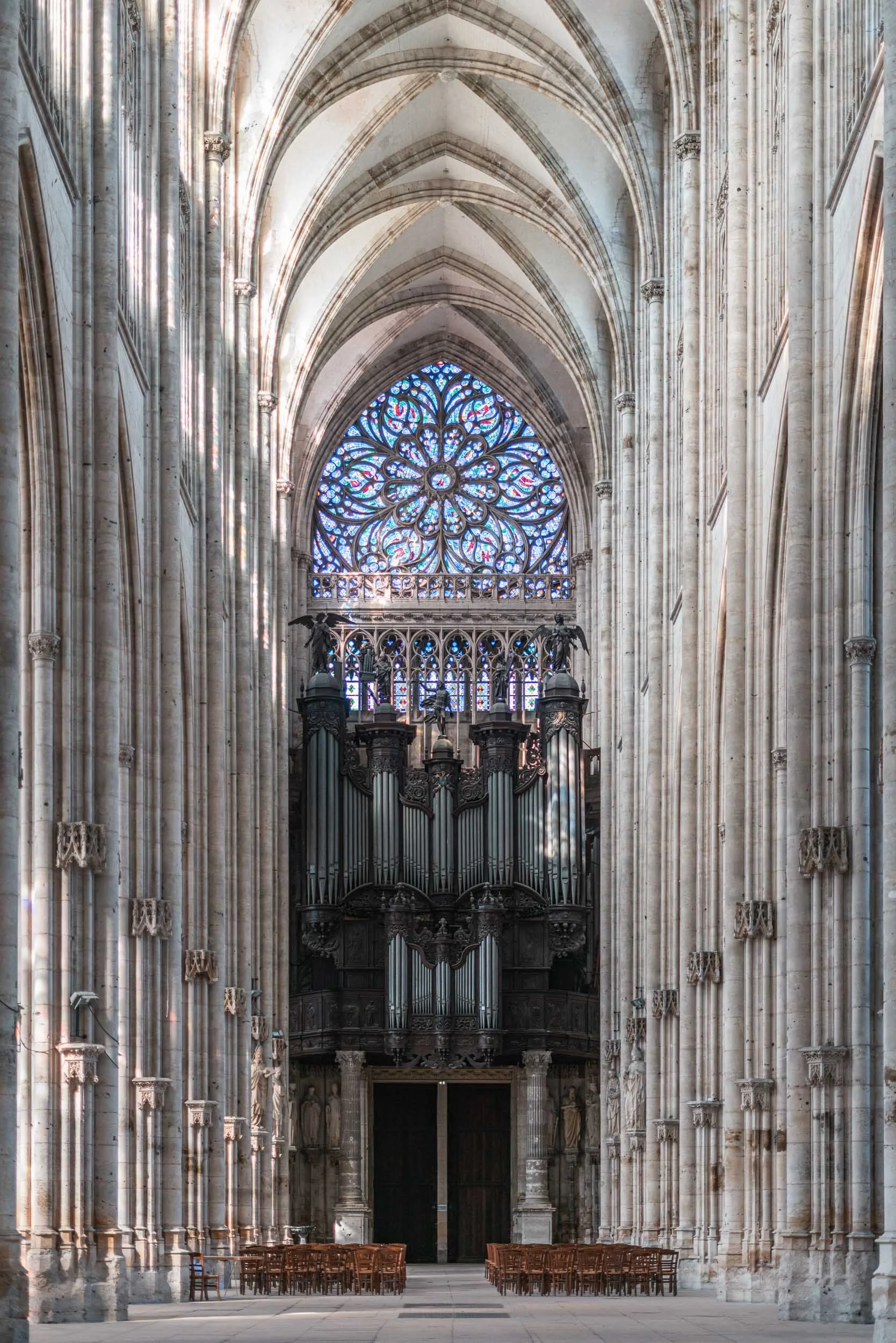
Architecturally, it’s a textbook example of Rayonnant Gothic – that deliciously airy phase of Gothic architecture obsessed with light and intricate tracery. Step inside and the difference is immediate: the nave feels remarkably bright, with 14th‑century stained glass casting jewel‑coloured pools across otherwise pale stone and clear, frosted panels. It’s dramatic, but in a calm, luminous way rather than in full dark-and-moody Gothic gloom.
Then there’s the organ. Housed in a grand oak case, the 19th‑century instrument by Cavaillé‑Coll is considered one of the finest in France – the sort of organ that makes you seriously reconsider your life choices if you didn’t learn music. Catch it during a concert, and the whole space vibrates; even a simple chord feels like a full-body experience.


Outside, the abbey is a dream for anyone who loves a good buttress. From the old abbey gardens, you get a perfect view of its forest of flying buttresses, the elegant chevet and the 88‑metre lantern tower rising over the crossing in classic Norman fashion, with bells tucked away inside.
St Ouen may not have the crowds of the cathedral, but that’s precisely its charm. It’s where you go when you want soaring Gothic architecture, stained-glass drama and a bit of room to breathe.
Church of St Maclou (Eglise Saint-Maclou)
The Church of St Maclou sits just east of Rouen’s historic centre, a short walk from the cathedral, and forms the city’s Gothic power trio alongside St Ouen and Notre‑Dame. Smaller but no less dramatic, it’s one of France’s finest examples of Flamboyant Gothic – ornate stone lacework, sharp gables, and a wonderfully theatrical façade without towers, crowned by a soaring spire.
Funded by wealthy merchants and built after the Black Death, St Maclou leans into the macabre: its decoration nods to mortality and plague, giving the church a slightly haunted, introspective air. Inside, the chapels are relatively bare thanks to Revolutionary looting, but the surviving Renaissance doors and organ escaped destruction, adding layers of history to the space.
Churchyard of St Maclou (Aître Saint-Maclou)
St Maclou churchyard lies in plain sight just behind the church, a short walk east of the cathedral. Step through a modest doorway, and you’re suddenly in one of Europe’s rare surviving plague cemeteries, a quiet courtyard ringed with seemingly charming half-timbered galleries – until you look closer.
During the Black Death of 1348, thousands of parishioners were buried here; later epidemics led to the exhumation of earlier bones, which were stored in the surrounding buildings, which served as an ossuary. Carved into the beams are skulls, bones, spades, hourglasses, and other cheerful reminders of mortality, plus a famously mummified black cat near the entrance.
Once used by a fine arts school, the space now feels eerily calm: part open-air museum, part memento mori. It’s unsettling and beautiful in equal measure – a stark reminder that behind Rouen’s pretty façades lie centuries of very real human drama.
Rouen Courthouse (Palais de Justice de Rouen)

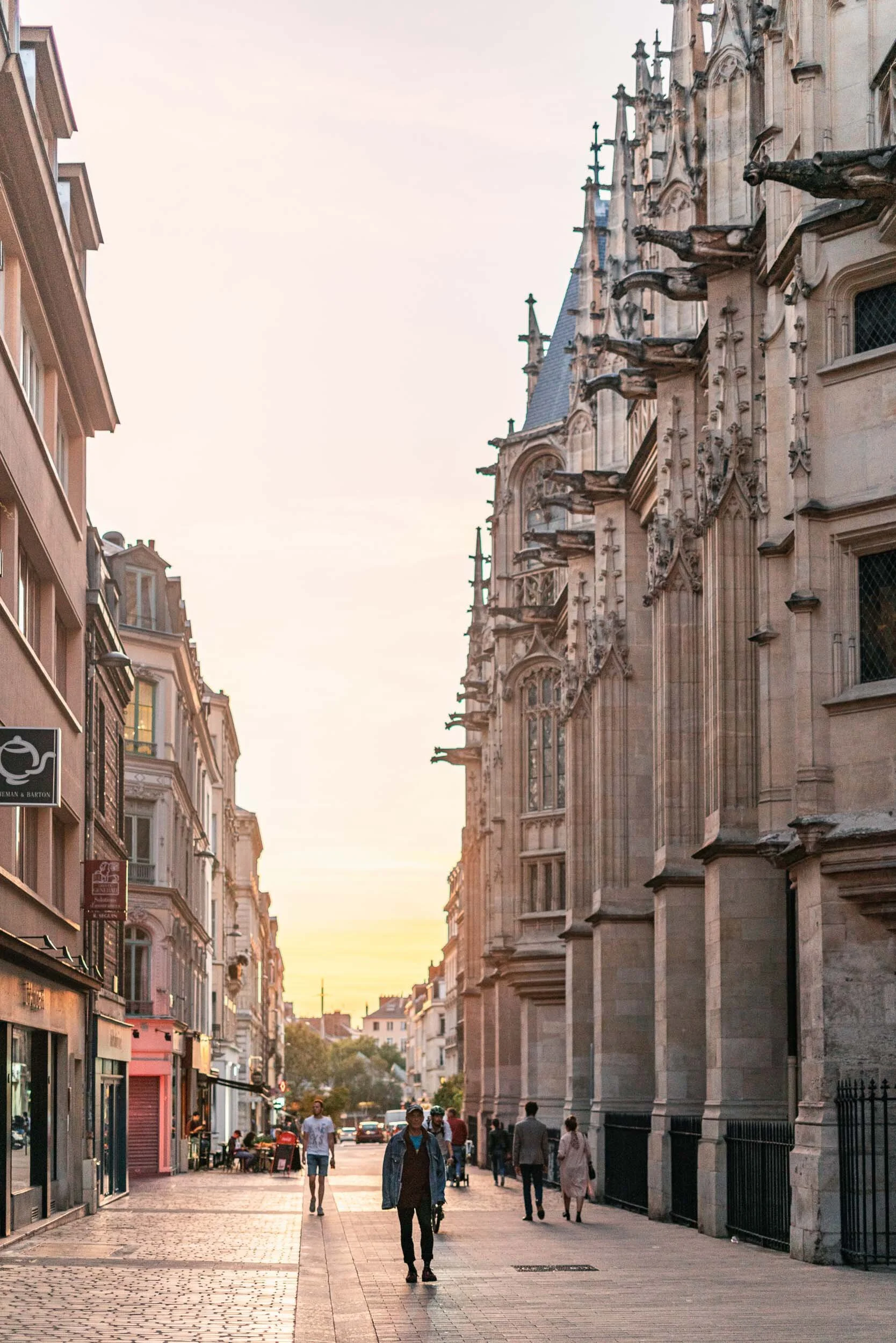
The courthouse rises just off Rue Jeanne‑d’Arc, a short stroll from the old town, and looks more like a storybook palace than a place where you’d argue about legal technicalities. This lavish Gothic complex was once the seat of the Parliament of Normandy and is still used today as a court of appeal, which feels wildly dramatic given the spires, gargoyles and flamboyant stonework.

Built mainly in the 16th century on the site of Rouen’s former Jewish quarter, it has been extended and altered over the centuries, then painstakingly restored after heavy damage in the Second World War. Stand by the railings and let your eye climb over the ornate façade, but don’t miss the details at street level: along Rue Jeanne‑d’Arc, the stone is still pitted with shrapnel and bullet scars, a sobering, physical reminder of the 1944 bombings. It’s this contrast that makes the courtyard so compelling: exuberant late Gothic fantasy from afar, layered with traces of persecution, destruction and survival when you step closer.

Museum of Fine Arts (Musée Des Beaux-Arts)
Rouen’s Museum of Fine Arts sits a short walk from the Tower of Joan of Arc, and it punches well above the city’s weight. Housed in a light‑filled 19th‑century building, it holds one of France’s most important public collections, spanning everything from early Renaissance altarpieces to modern works.
The line‑up is star‑studded: Perugino, Veronese, Rubens, Caravaggio, Velázquez, Poussin, and more, plus a superb haul of Impressionists thanks to industrialist François Depeaux, whose 1909 donation gifted the museum works by Monet, Sisley, Caillebotte, Pissarro, Degas and Renoir. Rouen now boasts France’s second‑largest Impressionist collection, including one of Monet’s atmospheric studies of Rouen Cathedral, which feels deliciously meta after you’ve just seen the real thing outside.
There’s a noticeable emphasis on religious art (prepare yourself for an entire room dedicated to Joan of Arc), but the variety keeps it from feeling like homework. I especially loved the central glass‑roofed courtyard, dotted with monumental canvases and sculptures – a surprisingly civilised spot to sit with a coffee and pretend you’re an art critic.
Le Secq des Tournelles Museum (Musée Le Secq des Tournelles)
Opposite the Museum of Fine Arts, the Museum of Le Secq des Tournelles turns an entire 15th‑century church (St Laurent) into a shrine to wrought iron – and it’s far more captivating than it sounds on paper.
The collection began with Jean‑Louis‑Henri Le Secq Destournelles, a painter and early photographer who fell in love with the ironwork he was meant to document. Today, nearly 14,000 pieces fill the dim, vaulted space: everything from keys, hinges, balconies and gates to door knockers, shop signs, candlesticks and delicate domestic tools.
It feels a bit like wandering through a Gothic curiosity cabinet, where everyday objects are elevated to tiny sculptures. The fact that it’s housed in a deconsecrated church only adds to the mood – stained glass, high arches, and an ocean of black iron silhouettes.
Half-Timbered Houses


Rouen’s half-timbered houses are the city’s real scene-stealers – all crooked lines, pastel facades, and a faint sense that everything leans just a little more than is strictly sensible. You’ll find them thickest around Rue du Gros‑Horloge, the old market square, and the streets around St Maclou, where mediaeval lanes and cobbles complete the time-warp.
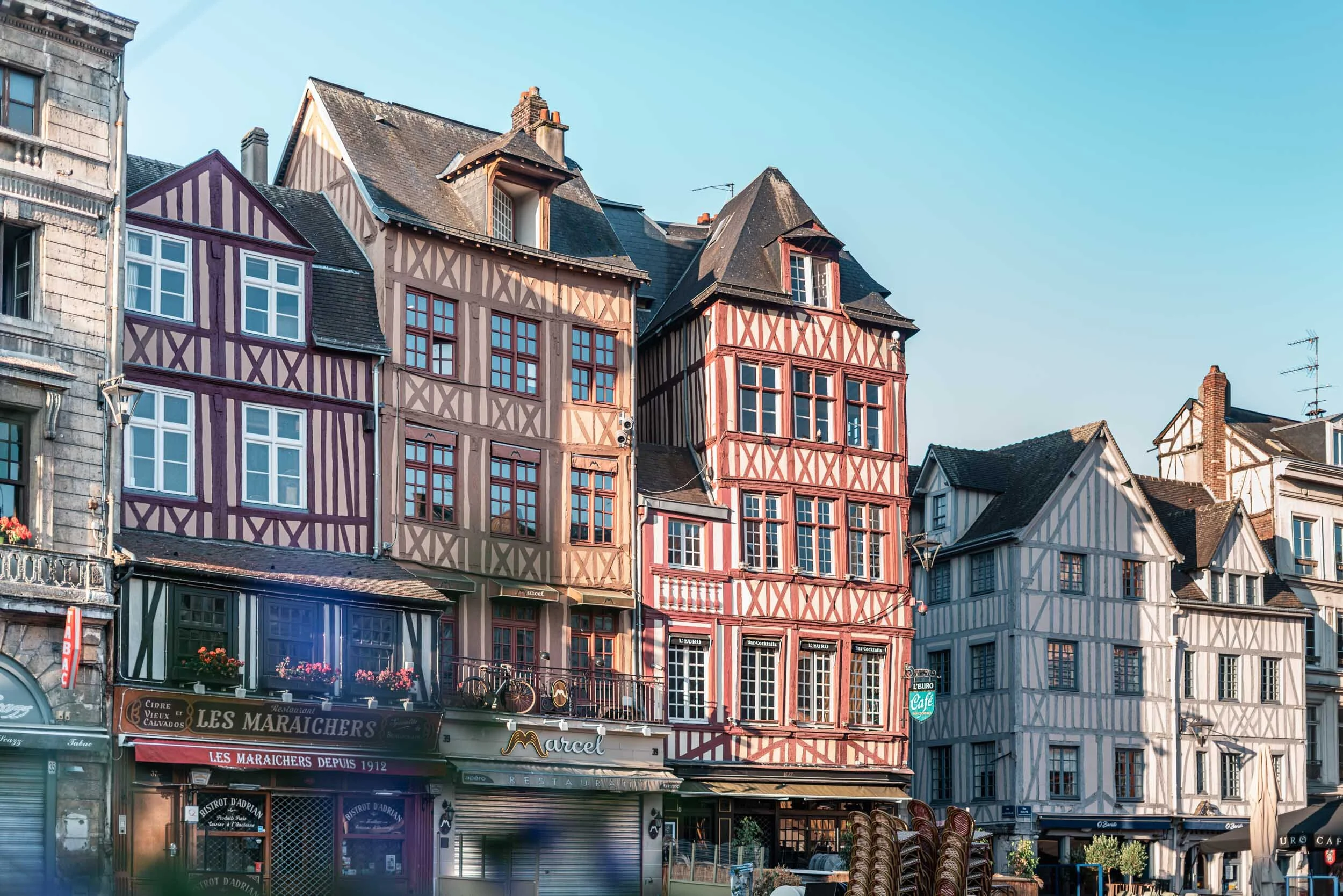
Built with a visible wooden frame and infill panels set on stone bases, many houses once flaunted carved oak corbels, allowing upper floors to jut out over the street. It wasn’t just decorative flair: property tax was based on ground‑floor footprint, so owners happily stacked their homes upwards and outwards. Unsurprisingly, this dense, overhanging style became a fire hazard, and corbelling was banned in the 16th century – yet plenty of gloriously eccentric examples survive.


Despite heavy bombing during the Second World War, Rouen still has around 2,000 half‑timbered buildings, roughly half of which are restored, and a good chunk of which are listed as historic monuments. Walking among them is a sensory hit: creaking beams, slanting doorways, faded carvings and paintwork in soft blues, greens and ochres.
It’s hard not to romanticise it all slightly. These houses aren’t museum props; they’ve watched over plagues, markets, revolutions and weekend shoppers, often within the same few metres of pavement. Come early or late in the day, when shopfronts are closed and shutters half‑drawn, and you get that delicious feeling of having stumbled onto the set of a period drama – minus the costume budget.
St Catherine Hill (Côte Sainte-Catherine)
St Catherine Hill rises to the east of Rouen, offering the city on a platter: the Seine looping below, bridges arcing across it, and a forest of spires pricking the skyline. It’s the classic postcard view of Rouen, famously painted by Claude Monet in his General View of Rouen, now in the Museum of Fine Arts – so yes, you’re standing in an Impressionist canvas.
From the Martainville tram stop, it’s about 10 minutes to the foot of the hill, then a steep climb of around 525 steps (15 minutes if you’re brisk, longer if you’re human). Wear proper shoes and take water; it’s short but punchy. At the top, you’ll find a quiet, grassy viewpoint perfect for sunset picnics, contemplating life, or just catching your breath while pretending you climbed it purely for artistic appreciation.
If you’re driving, there’s a free car park near the lookout, making it an easy detour en route to or from Paris.
Botanical Garden (Jardin des Plantes)
The botanical garden spans eight hectares and is open daily without charge. Today, it represents over 600 plant species. It also includes a rock garden, a rose garden, an orangery, and numerous greenhouses.
Rouen’s Botanical Garden sits in St Clément, on the south bank of the Seine, a little removed from the old town, which is exactly why it feels like a deep breath out. Spreading over eight hectares, it’s a classic 19th‑century French garden with pleasantly old‑fashioned charm: a rose garden, a rock garden, an elegant orangery, and a cluster of glasshouses sheltering exotic species when Normandy decides to be, well, Normandy.
Home to more than 600 plant species, it’s free to enter and open daily, making it an easy, low‑effort escape when you’ve had your fill of spires and cobblestones. Expect locals walking dogs, children tearing around the lawns, and the occasional visitor sprawled on a bench pretending to read.
Abbey of St Georges of Boscherville

View of the main structure and abbey gardens from above
The Abbey of St Georges of Boscherville sits in the village of St‑Martin‑de‑Boscherville, about a half‑hour’s drive west of Rouen. Perched above the Seine valley, it’s close enough for an easy half‑day trip yet far enough to feel like a proper escape.
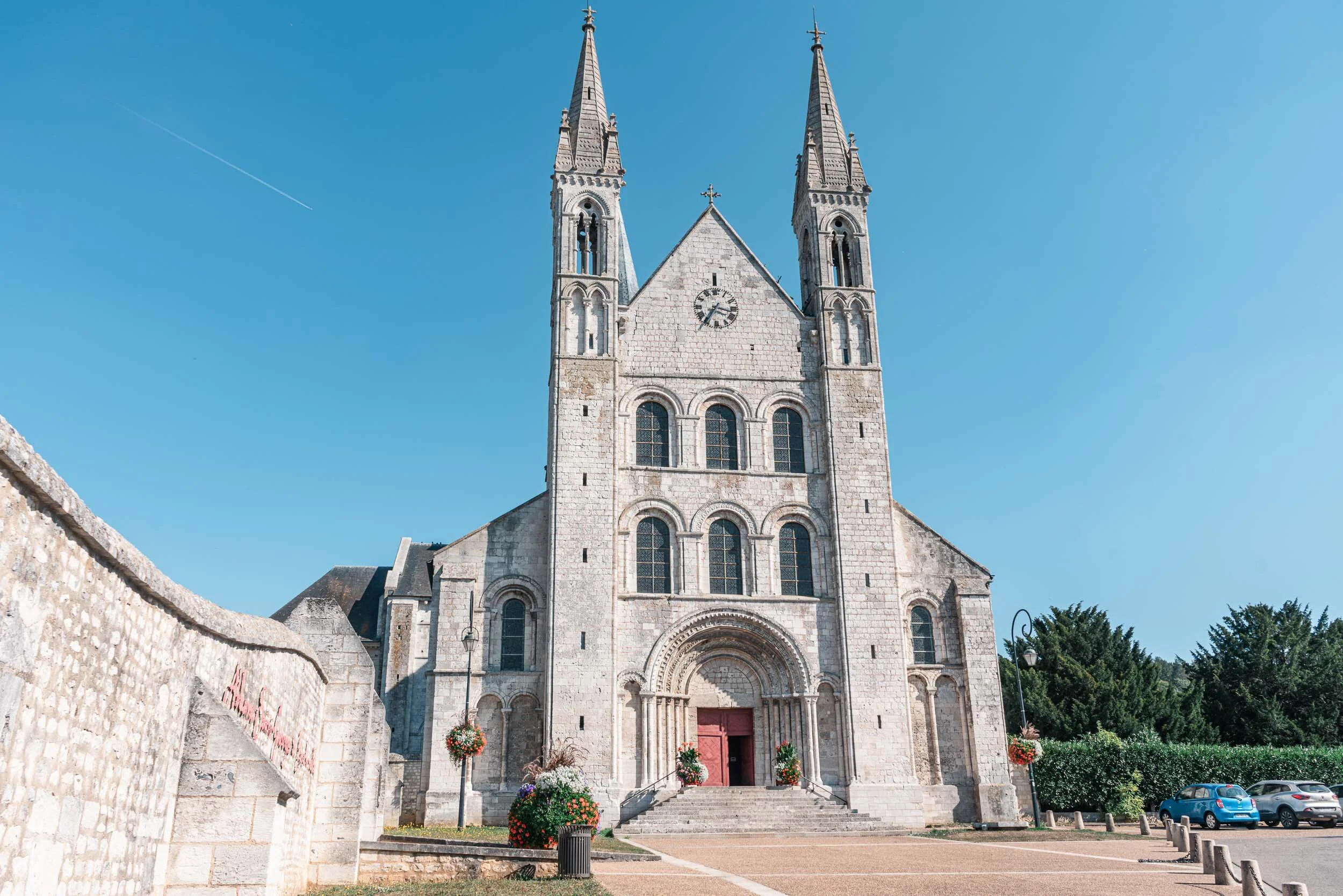
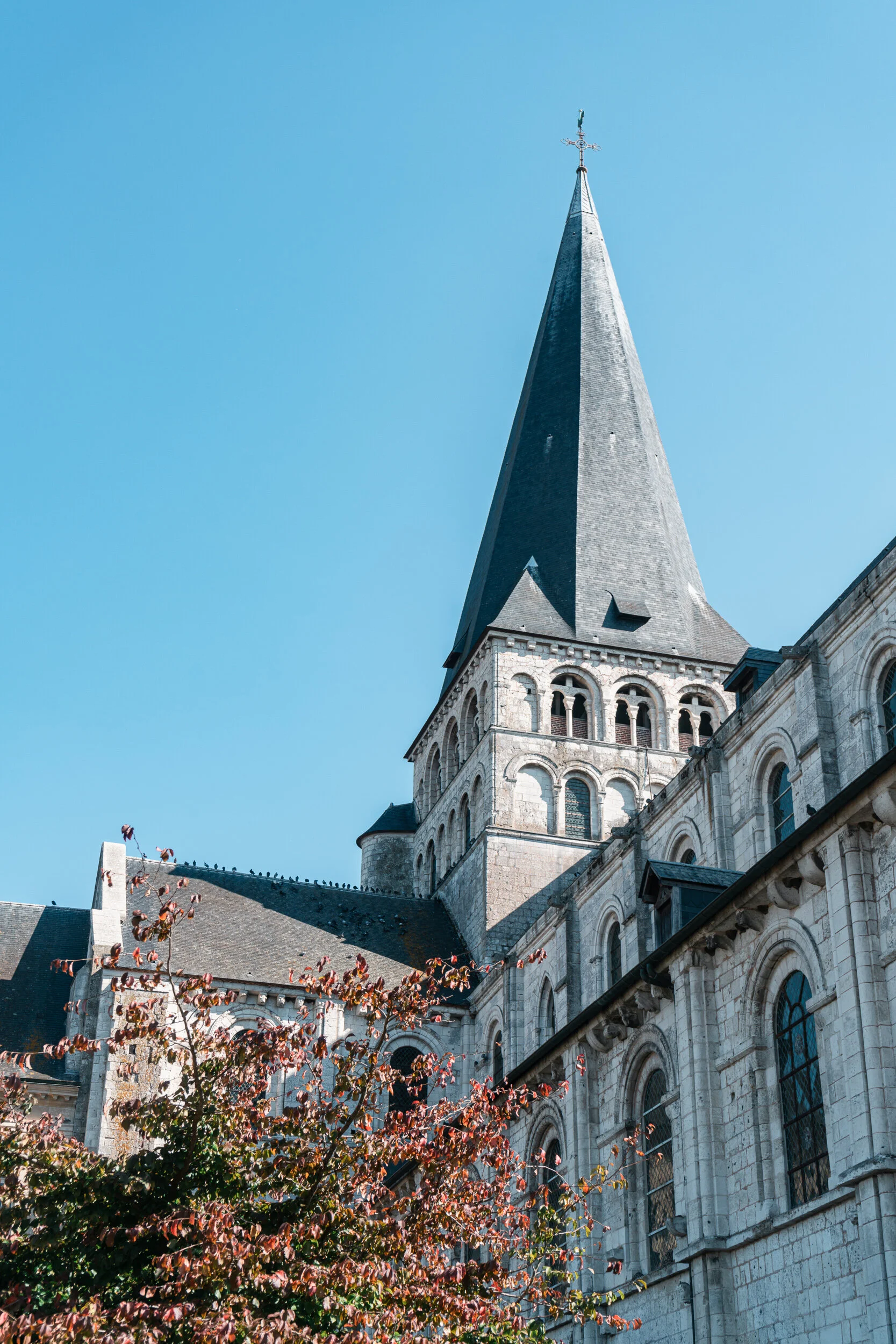

Founded in the 12th century, the former Benedictine abbey is a textbook example of Norman Romanesque architecture: thick stone walls, rounded arches and a calm, measured proportion that feels almost monastic even before you’ve stepped inside. The abbey church, monastic buildings and chapter house are all listed as Monuments Historiques, France’s way of saying, “Hands off, this one’s special.” Inside, the church is simple yet quietly majestic – less about gilded drama, more about powerful, grounded stone and soft light.


A beautiful trellis tunnel near the abbey entrance

Apples are a hallmark of Normandy
Then you step into the gardens, and everything opens up. Behind the abbey, a vast formal garden stretches across terraces, with orchards, geometric parterres, medicinal plants and a small hedge maze that delights children and adults alike. From the upper levels, you get gorgeous views over the Seine valley and surrounding countryside, which look almost theatrically well‑composed at golden hour. It’s romantic without trying too hard, blissfully free of the jostling you sometimes get in Rouen’s historic centre.

The abbey gardens are located on a slope and the top makes for a magnificent view of the beautiful terrace


An aerial view of the commune
What to Eat
Prélude Café
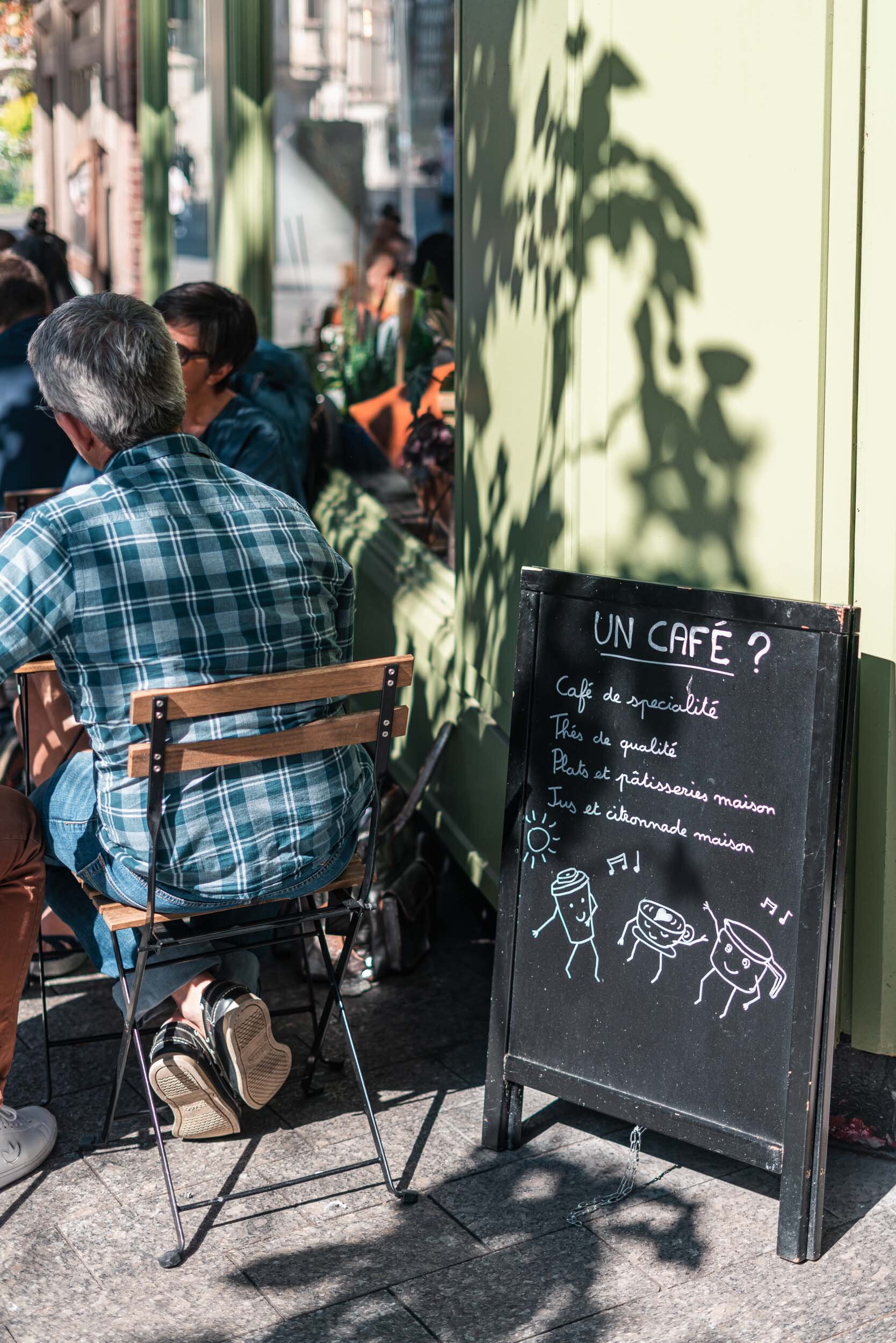
The crowd at Prélude Café is mostly local

The cafe specialises in assorted bowls for their lunch menus
Prélude Café occupies a pretty sage‑green corner on Place de la Pucelle, a few minutes’ walk from the cathedral. Inside, it’s bright, minimalist and quietly Scandinavian, with serious attention to speciality coffee (often Nordic‑style roasts). Expect short, seasonal brunch‑leaning menus, excellent pastries and thoughtfully balanced, veggie‑friendly plates.

A corner of Place de la Pucelle

Artefact
Artefact sits a short walk from the cathedral, blending a speciality coffee shop with a mini design gallery. Inside, it’s calm and minimalist: pale wood, clean lines, and curated ceramics. They’re known for carefully sourced espresso and filter coffee, homemade cakes, and light, seasonal plates that feel more “Nordic café” than traditional French.
Standard Café & Beaux Objets
Standard Café & Beaux Objets, near the Musée des Beaux-Arts, blends third‑wave coffee with a boutique of stylish “beautiful objects.” Expect a bright, design‑forward space, rotating artful homewares, and well‑pulled espresso. They’re known for quality coffee, simple brunch options, and pastries served in a subtly hip, gallery‑like setting.
OKTO
OKTO sits near the Gros Horloge, a contemporary bistro with clean lines, slate tones and an open, buzzy feel. The kitchen leans towards modern French with Mediterranean touches: small, seasonal menus, clever vegetable work and polished plates without stiffness. Known for good-value lunch formulas, natural-leaning wines and sharp, ingredient‑first cooking.
Markette
Close to the Museum of Fine Arts, Markette feels like a laid‑back neo‑bistrot: blond wood, plants, an open kitchen, and friendly bustle. The blackboard menu changes frequently, highlighting local, seasonal produce in modern French comfort dishes. Expect generous plates, inventive desserts, and a solid wine selection at prices that attract as many locals as visitors.
Tandem
Tandem, just by the Church of St Maclou, is run “in tandem” by Fabien in the kitchen and Victoria front of house. Behind its chic black façade and terrace lies a cosy, contemporary dining room. The refined, seasonal menu changes every couple of months, showcasing market‑driven French cuisine, elegant plating and a concise, thoughtful wine list.
La Marmite
La Marmite (“the pot”) pairs monochrome interiors with an intimate, family‑run warmth. Self‑taught chef Frédérique Antoine brings a delicate, feminine touch to beautifully presented, market‑led French dishes, while her husband, Jean‑Luc, orchestrates the dining room. Known for carefully balanced flavours, generous portions, and plates that look as good as they taste.
Au Flaméron
Near the historic centre, Au Flaméron offers refined French‑Japanese fusion in a calm, minimalist setting. Japanese chef Takahiro Oikawa crafts dishes entirely from organic, seasonal, largely local produce. Expect precise sauces, immaculate plating and flavour combinations that often rival those of Michelin‑starred kitchens, all delivered with quietly attentive service and a compact, well‑chosen wine list.
Simone
Opposite the Church of St Maclou, Simone’s green frontage, set beneath a colourful half‑timbered house, sets an inviting tone. Inside: relaxed bistro vibes, closely packed tables, and shelves of bottles. The short blackboard menu focuses on fresh, seasonal French plates at fair prices, backed by an excellent, wide‑ranging wine list, making it a local favourite.
Goupil
Tucked away in the old town, Goupil feels like a modern wine‑centred bistro: brick, wood, candlelight and a friendly hum. The menu is concise and seasonal, leaning towards creative small plates for sharing. It’s especially loved for its well‑curated natural and biodynamic wines and generous charcuterie and cheese boards.
La Taverne Saint-Amant
Near the historic centre, La Taverne Saint‑Amant is a cosy, wood‑panelled spot specialising in hearty Alpine comfort food. The big draw is the all‑you‑can‑eat raclette, with molten cheese, charcuterie and potatoes on repeat, plus other Savoyard classics. Expect a relaxed, bustling atmosphere, perfect for cold evenings and unfussy indulgence.
Paul-Arthur
Paul‑Arthur, close to the Church of St Joan of Arc, offers an intimate bistronomic setting: exposed stone, warm lighting and quietly elegant table settings. The kitchen delivers modern French cuisine using classic techniques, precise seasoning and seasonal ingredients. Known for excellent-value fixed‑price menus, polished desserts and attentive, unpretentious service that feels more like a neighbourhood gem than a formal destination.
L'Epicurius
L’Epicurius, near the centre, channels contemporary fine‑bistro energy: dark tones, soft lighting, and an open kitchen. The ever-changing menu focuses on seasonal, locally sourced produce, treated with gastronomic flair—think inventive starters, carefully cooked meats and fish, and indulgent desserts. It is appreciated for its well‑priced tasting menus and a wine list tailored to food lovers.
L’Écuyer
L’Écuyer, tucked away in Rouen’s historic centre near the cathedral, feels like a cosy, wood‑and‑brick neighbourhood bar. Expect a relaxed, slightly bohemian crowd, rotating craft beers and simple cocktails at fair prices. It’s popular for after‑work drinks, terrace people‑watching and an unpretentious local vibe rather than high‑end mixology theatrics.
L’Estaminet Bieres & Cocktails
L’Estaminet, close to the Gros Horloge, channels a lively, slightly vintage pub atmosphere: dark wood, posters, and a chatty bar. Renowned for its extensive beer list and solid classic cocktails, it draws a mixed crowd of students and locals, especially on weekends and match nights. Lively, noisy, reliably fun.
Le Petit Bar Cocktails
Le Petit Bar Cocktails, near the old market square, is exactly what it promises: small, intimate, and all about drinks. Inside, low lighting, snug tables, and a friendly team shaking well‑balanced classics and house signatures. Known for creative cocktails, good-value happy hours, and a relaxed, date‑night‑friendly atmosphere.
Where to Shop
Old Market Square (Place du Vieux-Marché)

Market stalls on Place du Vieux-Marché in the early morning light
The old market is Rouen’s most atmospheric square and the easiest place to slip into local life. West of the cathedral, it’s framed by colourful half‑timbered houses, cafés and the striking modern Church of St Joan of Arc, whose sweeping roof shelters covered market stalls.

There were only a handful of stalls, but the variety of produce offered was impressive
A small daily market runs here (mornings are best), with stalls selling fruit, vegetables, cheese, charcuterie and flowers. It’s more compact and slightly more touristy than St Marc, but perfect if you’re staying in the old town. Grab cherries, a wedge of Camembert and a baguette, and you’ve got an instant Seine‑side picnic.
Despite the history – this is where Joan of Arc was executed in 1431 – the mood is surprisingly cheerful. Terraces spill into the square, locals pick up groceries, and you’re never far from the clink of coffee cups or wine glasses.

Sleepy Rouen before the tourists start flocking in
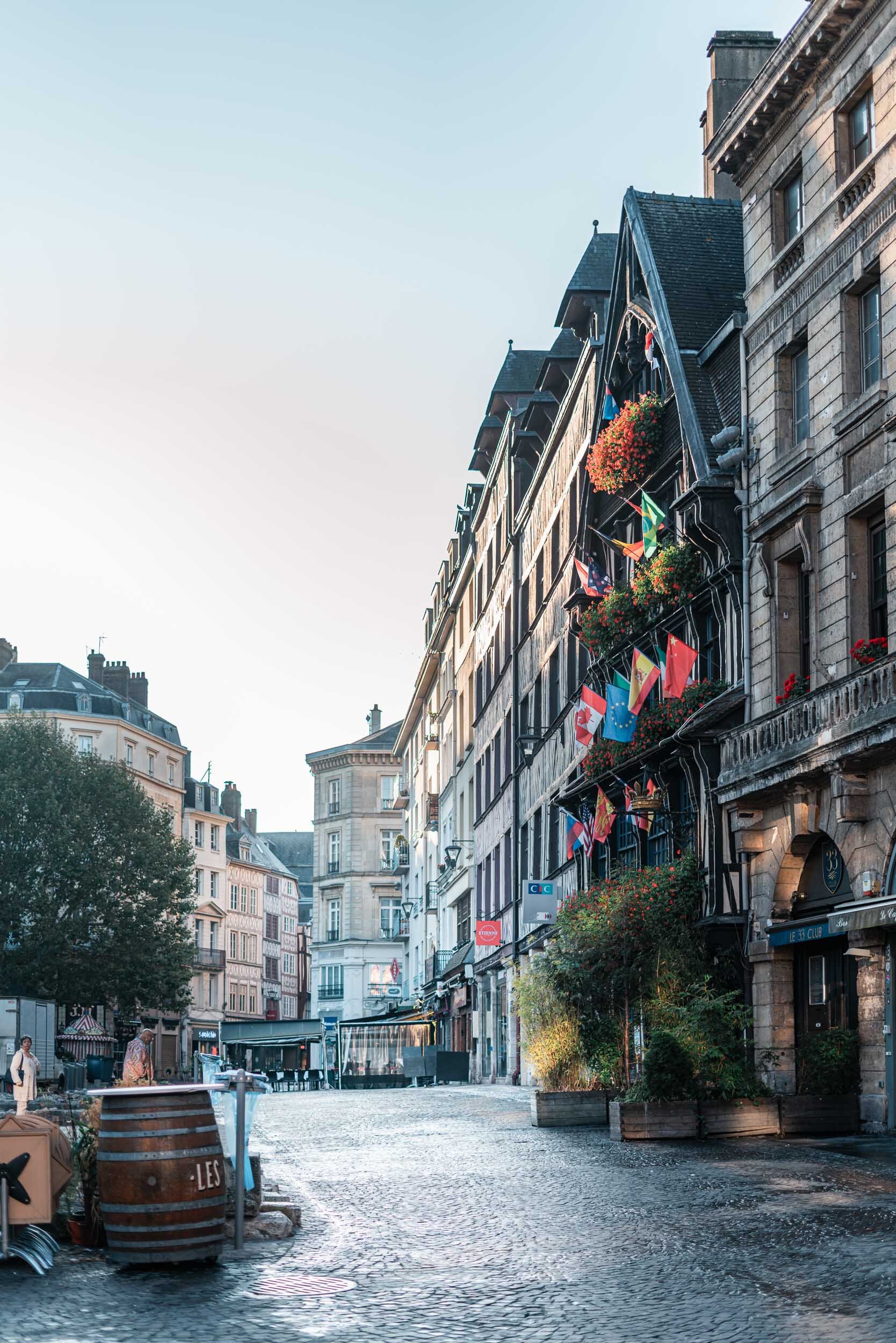
Come autumn, the square becomes a celebration of Norman food during the Fête du Ventre (“Festival of the Belly”), when producers fill the streets with cider, cheeses, apples, sausages, pastries and more. It’s busy, noisy and deliciously tempting.
Even without an agenda, wandering through the market, listening to the market chatter and watching everyday rituals unfold is one of Rouen’s simple pleasures.
St Marc Market (Marché Saint-Marc)
On the eastern edge of the centre, beyond the Church of Saint‑Maclou, Place Saint‑Marc hosts Rouen’s largest and oldest market, dating back to the early 1800s. From Friday to Sunday (and on certain weekdays), the square fills with stalls selling seasonal produce, Normandy cheeses, oysters, charcuterie, pâtés, bread and pastries.
There are also flower stalls, street‑food trucks and bric‑à‑brac and antiques vendors, especially lively on weekends. The vibe is local and bustling; you’ll see Rouennais doing their weekly shop, lingering over coffee on surrounding terraces and haggling over vintage finds. It’s the market to choose if you want the full, noisy, authentic experience.
Emmurées Market (Marché des Emmurées)
South of the Seine, near the Joffre–Mutualité tram stop, the Emmurées Market serves the more residential Left Bank. Its name recalls a convent that once stood here, but today the square hosts a produce and flea market on Tuesdays and Saturdays, with Thursdays dedicated to antiques and second‑hand goods.
The food selection is smaller than at St Marc – think everyday fruit, veg, cheese and fish rather than destination shopping – but the antiques mornings can be rewarding if you enjoy rummaging for old books, linens, kitchenware or furniture. It’s low‑key, local and handy if you’re staying south of the river.
Halles Agrivin
In Rouen’s western quarter, a short walk from Docks 76 and the Gustave‑Flaubert Bridge, the red‑brick Halles Agrivinhas has been reborn as a contemporary food hall operated by Biltoki. Inside, artisan stalls – bakers, butchers, cheesemongers, fishmongers, greengrocers and wine merchants – sit alongside counters serving dishes made from their produce.
You can shop for ingredients, graze on tapas‑style plates, slurp oysters with a glass of white or share boards of charcuterie and cheese. The atmosphere is busy but convivial, especially at lunchtime and after work. Open most days except Monday, it’s an excellent stop if you’re exploring the docks area or craving a more modern, social market experience.
Where to Stay
Radisson Blu Hotel, Rouen Centre
Near Gare de Rouen Rive Droite, Radisson Blu Rouen Centre is ideal for train travellers, just a short walk from the historic core. Expect contemporary, light‑filled interiors in calm neutrals with the brand’s signature blue. Rooms are spacious; junior suites with terraces overlook the nearby Tower of St Joan of Arc. Fitness facilities and parking complete the business‑leisure mix.
Hôtel de Bourgtheroulde
On Place de la Pucelle in the very heart of old Rouen, this 15th‑century listed mansion is now a five‑star Autograph Collection hotel. Gothic‑Renaissance façades frame a grand courtyard. Inside, it’s boldly modern and glamorous, with a spa, a large indoor pool, a glass‑floored lobby, and a mix of traditional and contemporary rooms.
Hôtel Littéraire Gustave Flaubert
Tucked just off the old market, this BW Signature Collection hotel honours Rouen‑born writer Gustave Flaubert. Literary quotes, portraits and first‑edition reproductions adorn bright, contemporary spaces. Rooms are cosy, bookish and well soundproofed; some open onto a quiet courtyard. Guests appreciate the central yet peaceful location and the generous breakfast.
Aparthotel Adagio Access Rouen Centre Cathédrale
Housed in the restored Palais des Consuls complex by the Seine, Adagio Access offers modern studio and one‑bedroom apartments a short walk from the cathedral. Functional, compact units feature equipped kitchens, many with river views. Facilities include laundry, fitness room, private parking and pet‑friendly policies, making it ideal for extended or family stays.
Novotel Rouen Centre Cathédrale
Sharing the Palais des Consuls site with Adagio, this Novotel blends preserved stone walls and high ceilings with sleek, business‑leaning décor. Steps from the old town and the river, it offers comfortable rooms with courtyard or Seine views, a bar‑restaurant, an indoor pool and on‑site parking. Handy for both sightseeing and work trips.
Hôtel Paulette Rouen Centre Cathédrale
On a shopping street near Galeries Lafayette and the Cathédrale tram stop, Hôtel Paulette is a 22‑room boutique charmer. Think floral, Art Deco‑inspired wallpaper, plush headboards and clever use of space. Double‑glazed, soundproofed windows keep the noise down, and its central location makes it ideal for car‑free city breaks and cathedral‑hopping.
L’Escale du Gros Horloge
If you’re travelling in a bigger party of up to four people or are looking for a stylish apartment in the heart of the old town, L’escale du Gros Horloge can satisfy your needs. Newly opened in July 2022, It sits on the second floor of a historic building above Rue Massacre, which intersects Rue du Gros Horloge, one of Rouen’s most picturesque streets–as close as you can stay to the Gros Horloge.
Its deep, Prussian blue and mustard yellow colour palette, combined with warm woods, echos the grandeur of Gros Horloge and provides a warm alcove for your stay. It has a full kitchen, dining table, and laundry room to handle your daily needs.
Like most mediaeval buildings, however, it’s only accessible by stairs.
This post may contain affiliate links, meaning when you click the links and make a purchase, we receive a commission.
Related Posts
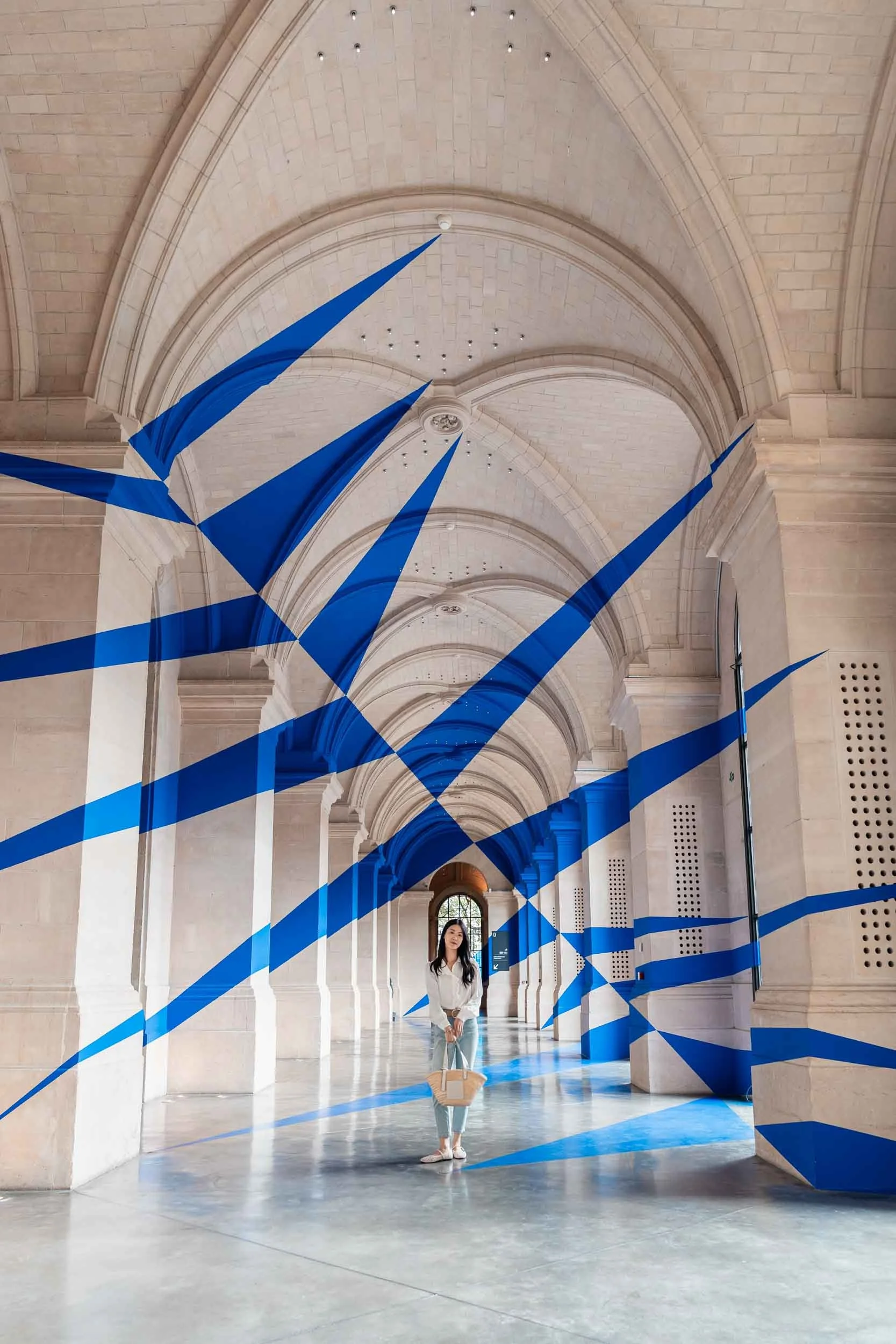



Step inside Villa Cavrois, a sunlit modernist chateau of yellow brick, cinematic interiors and a water mirror that makes you stop and stare.