
Echoes of the Past by Felice Varini: Walking Through Geometry in Lille
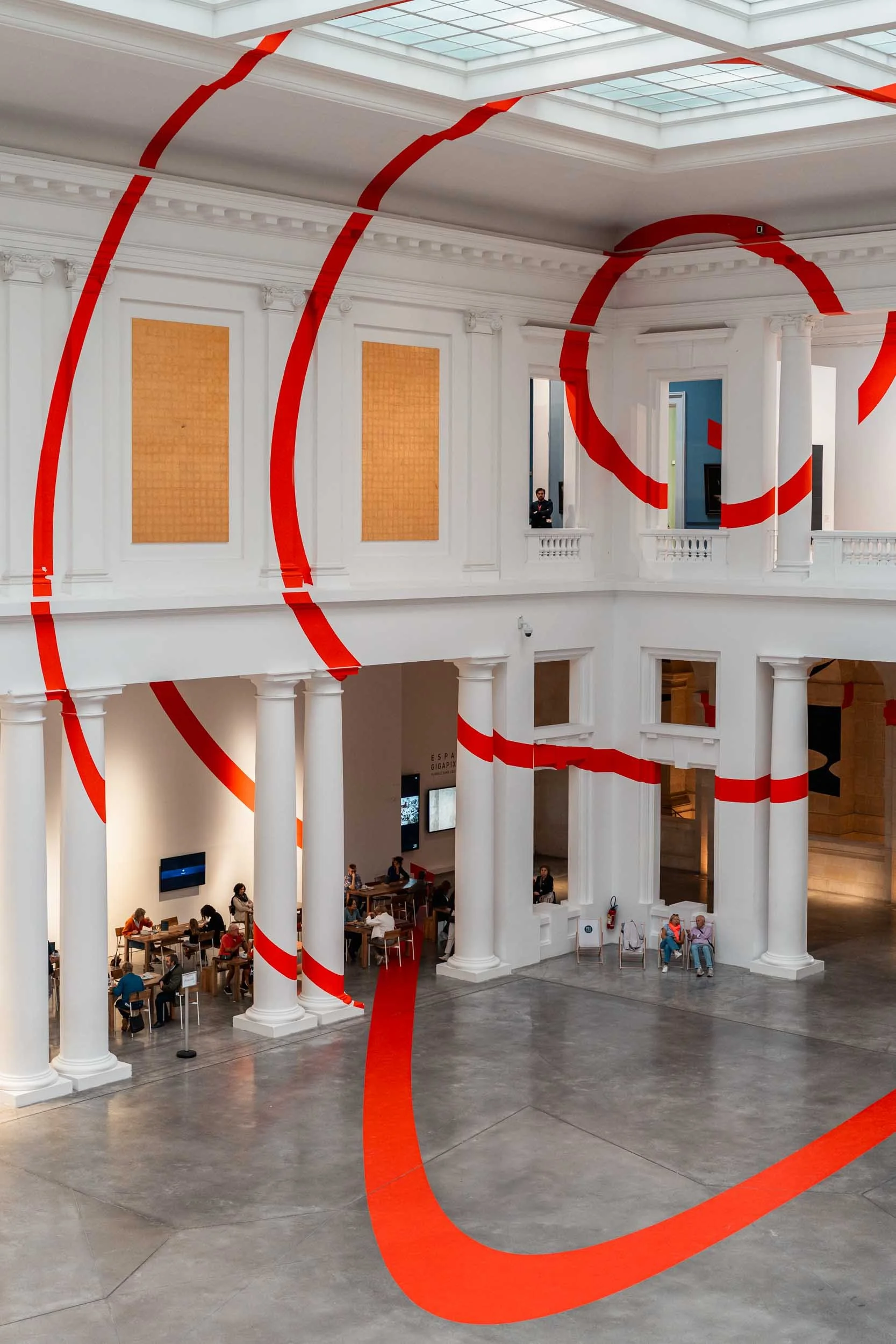
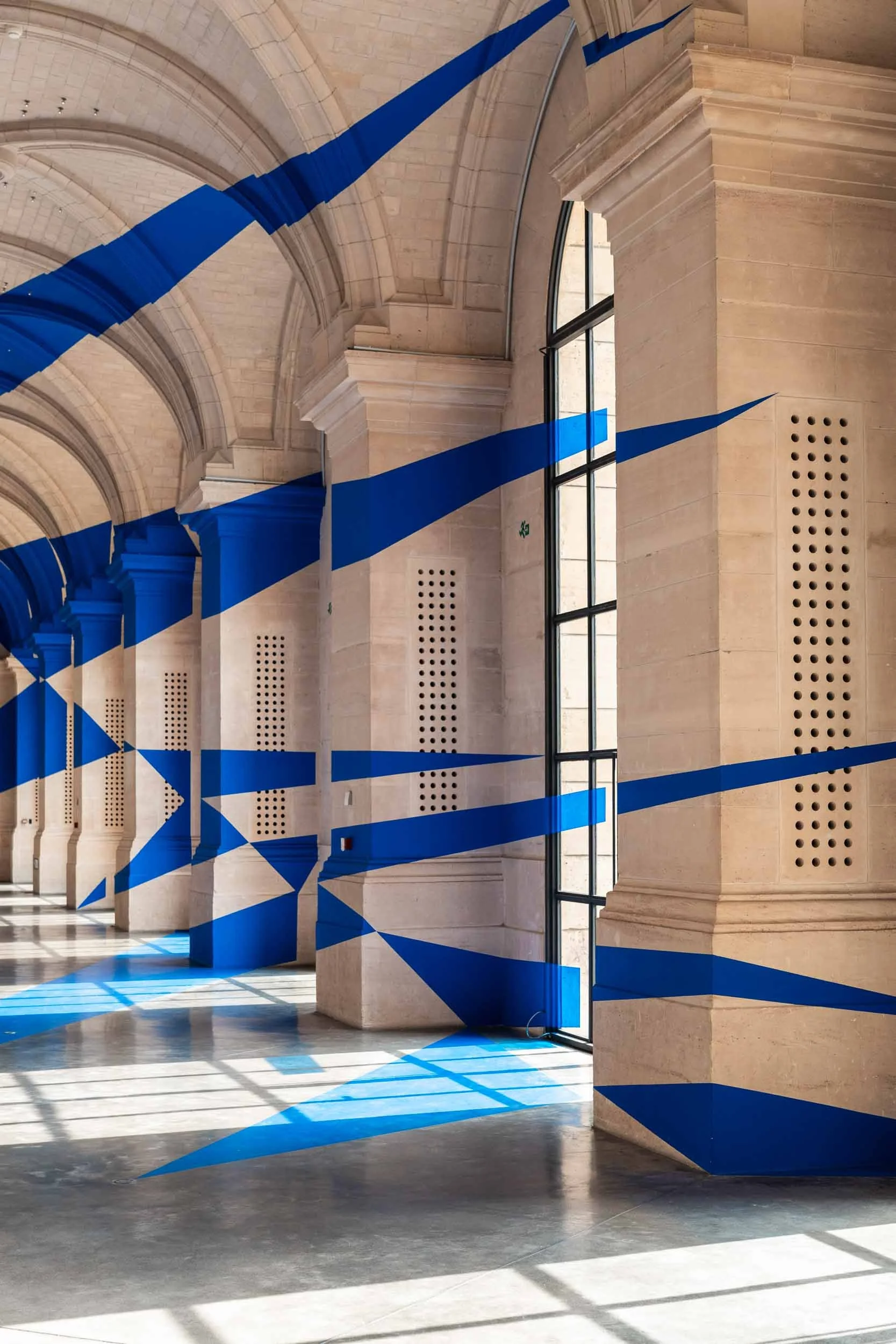
There are museum visits, and then there are museum apparitions – the kind where you walk into a very respectable fine arts building and suddenly find yourself inside a graphic designer’s fever dream. Echoes of the Past (Éclats en Échos) by Felice Varini at the Museum of Fine Arts (Palais des Beaux-Arts) in Lille firmly belongs to the second category. One minute you’re admiring marble columns; the next you’re being lassoed by concentric red circles and skewered – ever so elegantly – by electric-blue triangles. This isn’t just an exhibition you look at. It’s one you accidentally walk through, only to realise you’re the main character in someone else’s optical illusion.
Lille’s Museum of Fine Arts: Grandeur With a Plot Twist
Lille’s Museum of Fine Arts is one of France’s heavyweight museums – often dubbed a mini-Louvre for its serious collection of European painting, sculpture and decorative arts. The current building dates from the late 19th century, with confident stone façades, classical columns and a touch of industrial North‑French grit when you look closely.
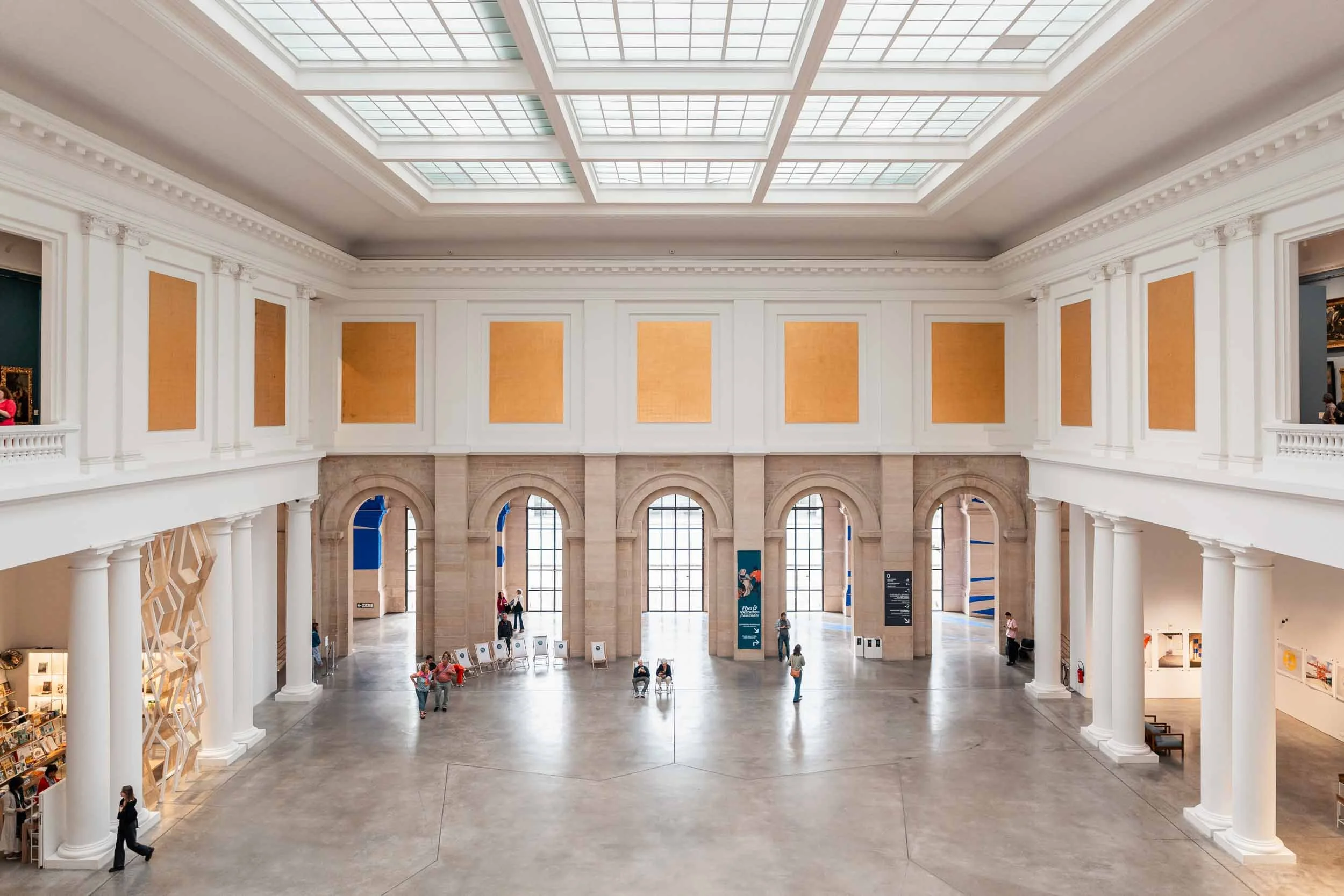
Inside, the architecture leans grand and ceremonial: high vaulted ceilings, long enfilades of galleries, and that iconic atrium – a luminous white box under a grid of glass skylights, looking purpose-built for dramatic entrances and existential crises. Traditionally, it’s the sort of place where you whisper about Rubens and Goya and feel faintly underdressed.
Which is precisely why Varini’s work hits so hard here. The clean lines, pale stone and generous voids become his canvas. The museum’s architecture – usually the silent backdrop to the art – suddenly becomes the main event.
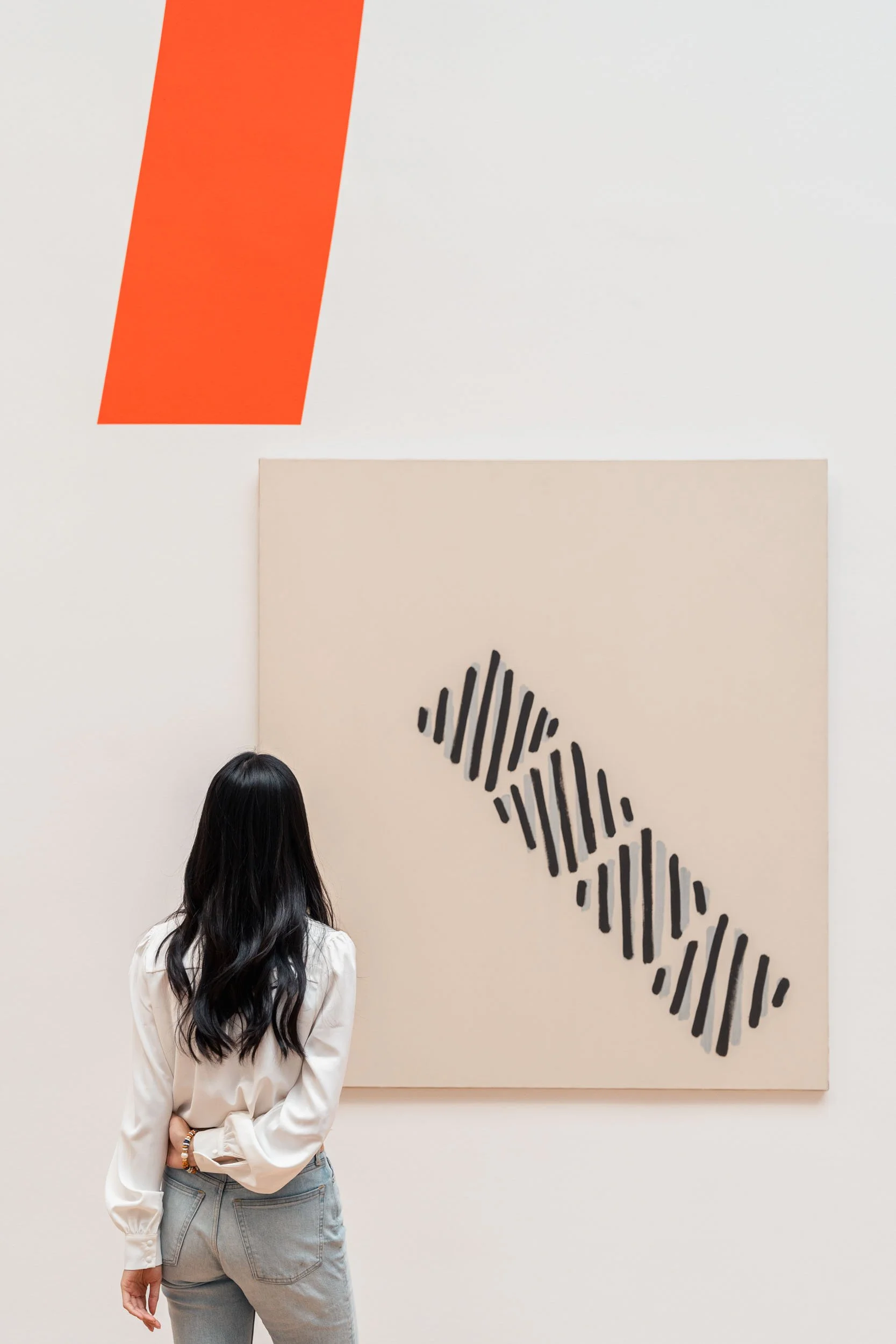
Meet Felice Varini: The Man Who Makes Walls Misbehave
Born in Switzerland and based in Paris, Felice Varini has flirted with architecture since the late 1970s. His thing is anamorphosis – large-scale geometric forms that resolve only from a very specific viewpoint. Move away from that spot and the perfect circle or stripe collapses into scattered shards across walls, ceilings, columns and floors.
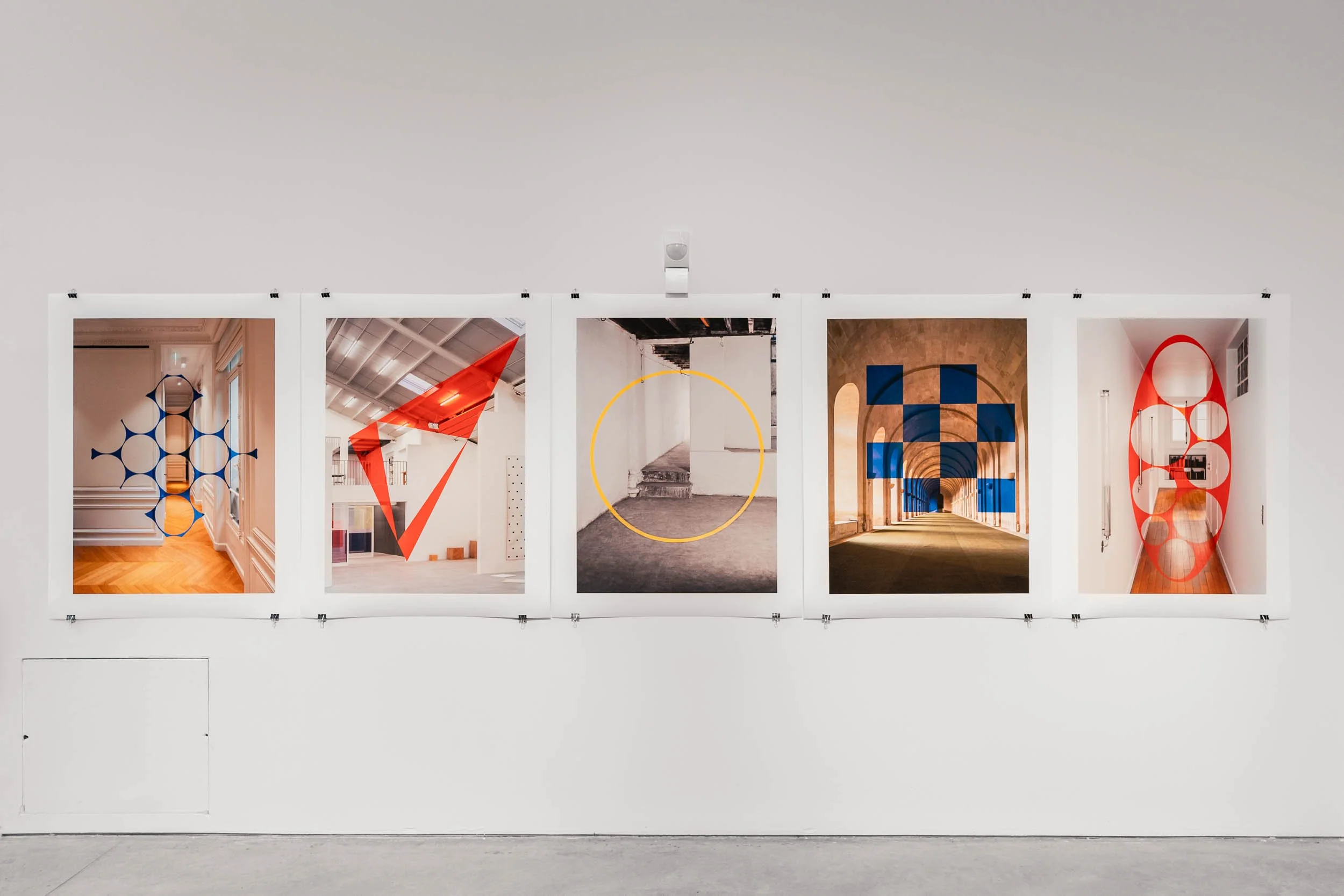
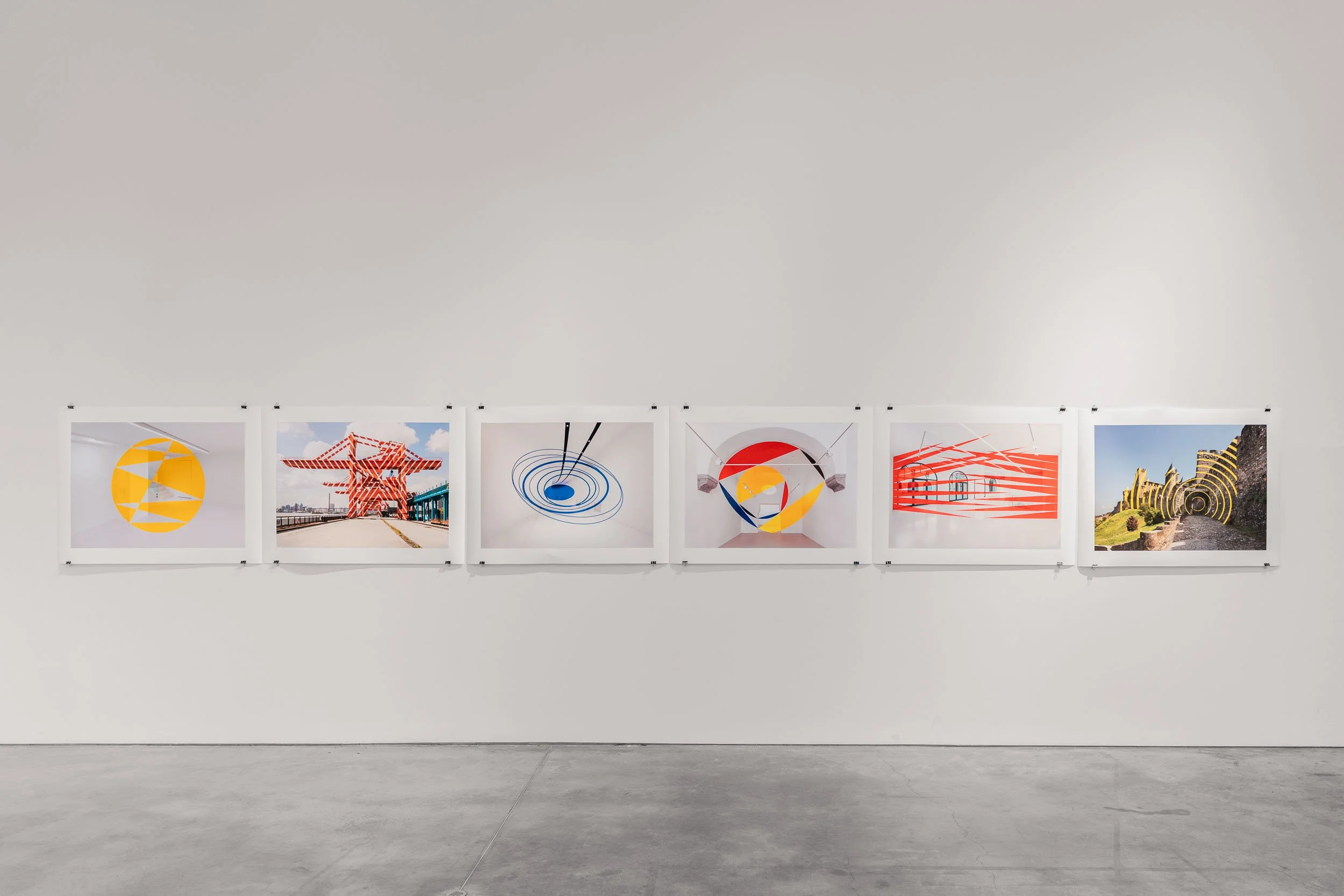
You might have seen his earlier interventions at the Grand Palais in Paris, the Cité Radieuse in Marseille, or the fortified city of Carcassonne. The recurring motifs are simple but bold: circles, triangles, diagonals, discs – graphic shapes that feel almost digital yet are painstakingly applied to real buildings.
In Echoes of the Past, that language of circles, lines and planes is pushed into dialogue with the museum’s classical volume. Varini’s background in site-specific urban and architectural interventions is crucial here: he’s less “artist hanging work in a gallery” and more “temporary co-architect”, re‑drawing how you understand the building itself.
Echoes of the Past: When It Finally Clicks
From 26 April 2025 to 30 June 2026
Walking into Echoes of the Past, I’ll be honest: at first, it looked like someone had rage‑quit a geometry lesson and thrown paint at several rooms. Bright shards of colour streak across the walls, skim dangerously close to historical artworks, and streak over arches and floors in unapologetic strips.
Nothing quite makes sense – until you find the spot.
From a precise vantage point, all those fragments suddenly snap together, and it’s pure sorcery. The lines align, the shapes lock in, and you find yourself inside a drawing that has decided to go 3D. It is bizarrely satisfying, a little surreal, and vaguely addictive.
The exhibition comprises three monumental installations, each with its own personality and colour mood, all created specifically for the museum as part of the lille3000 Fiesta season.
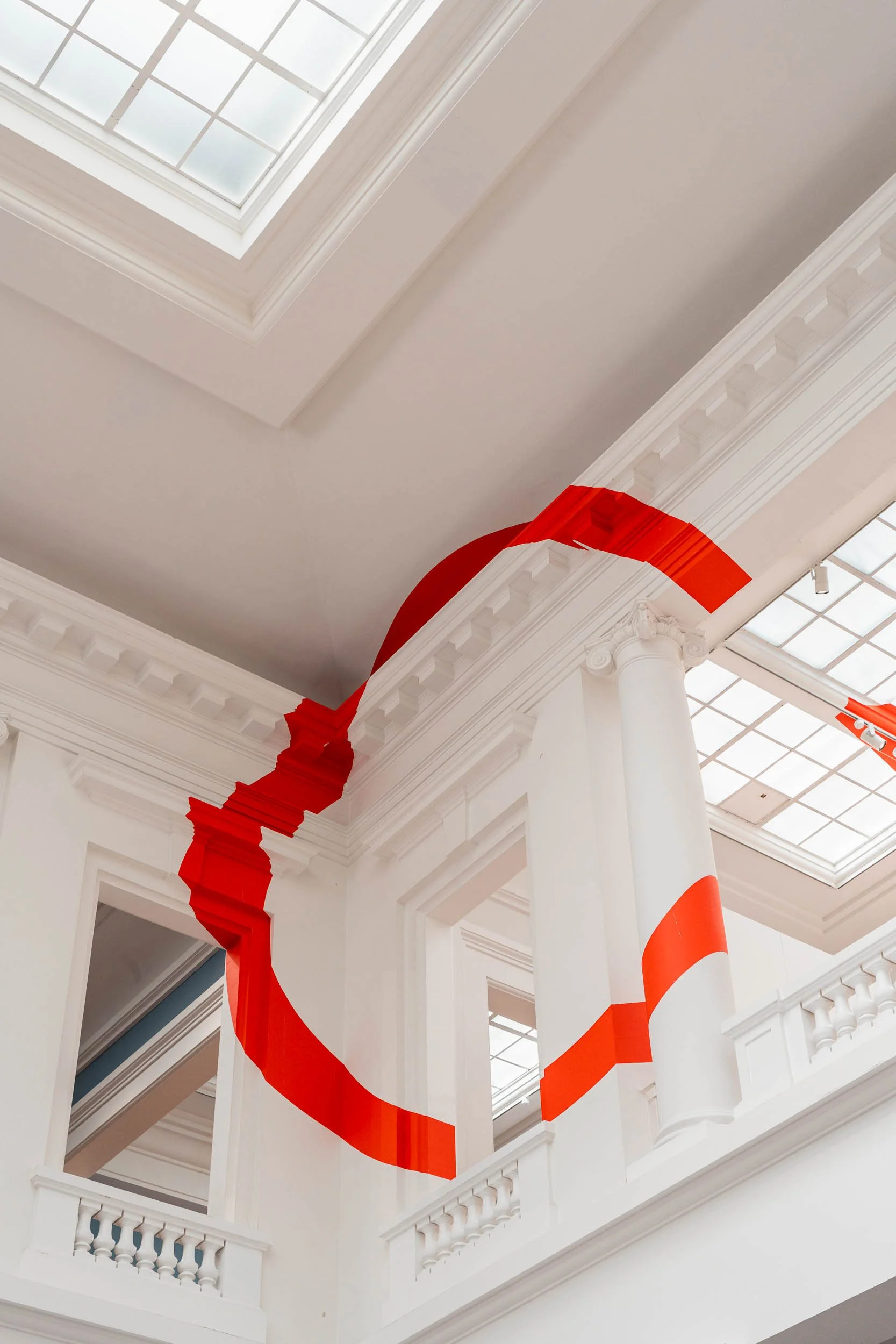
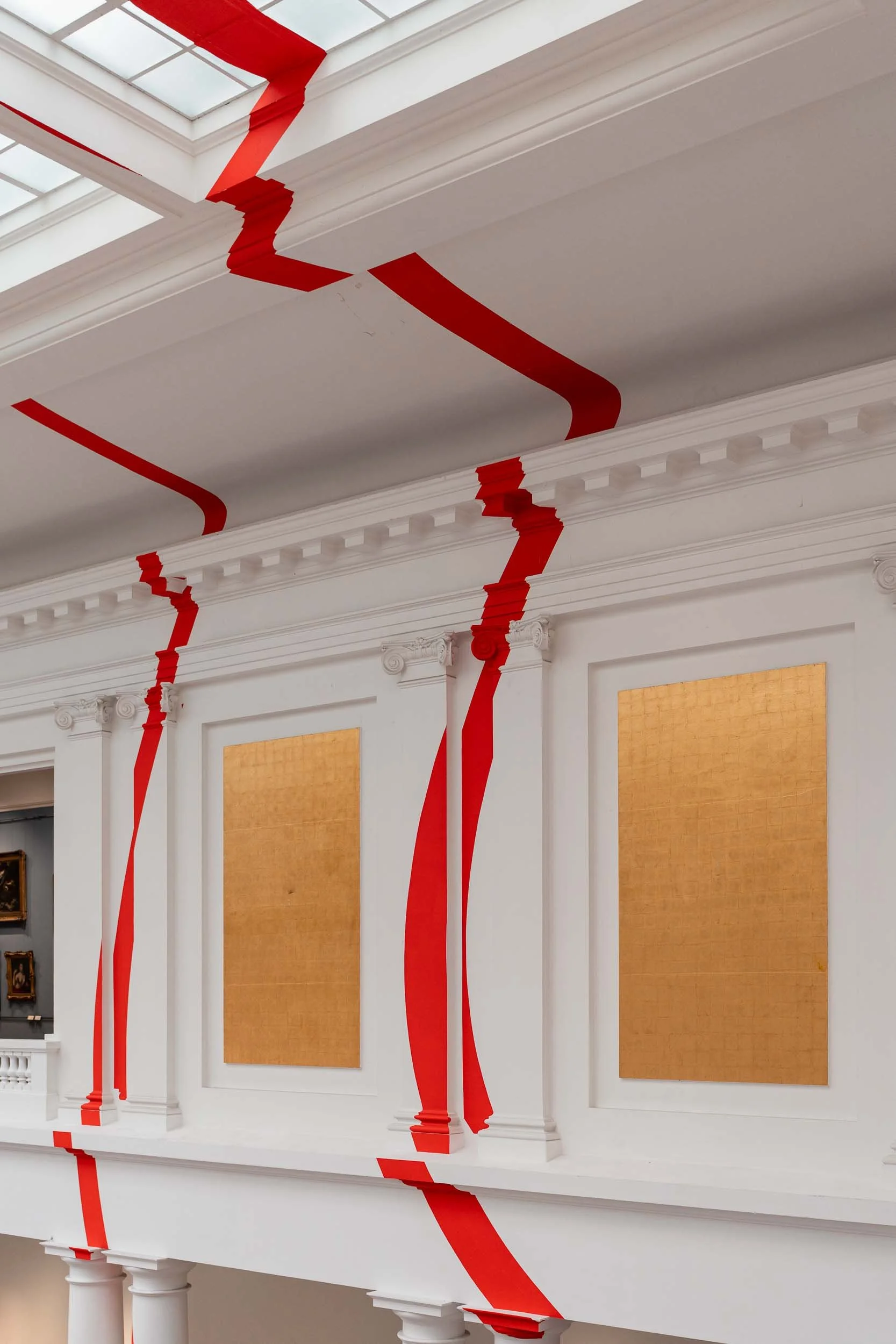
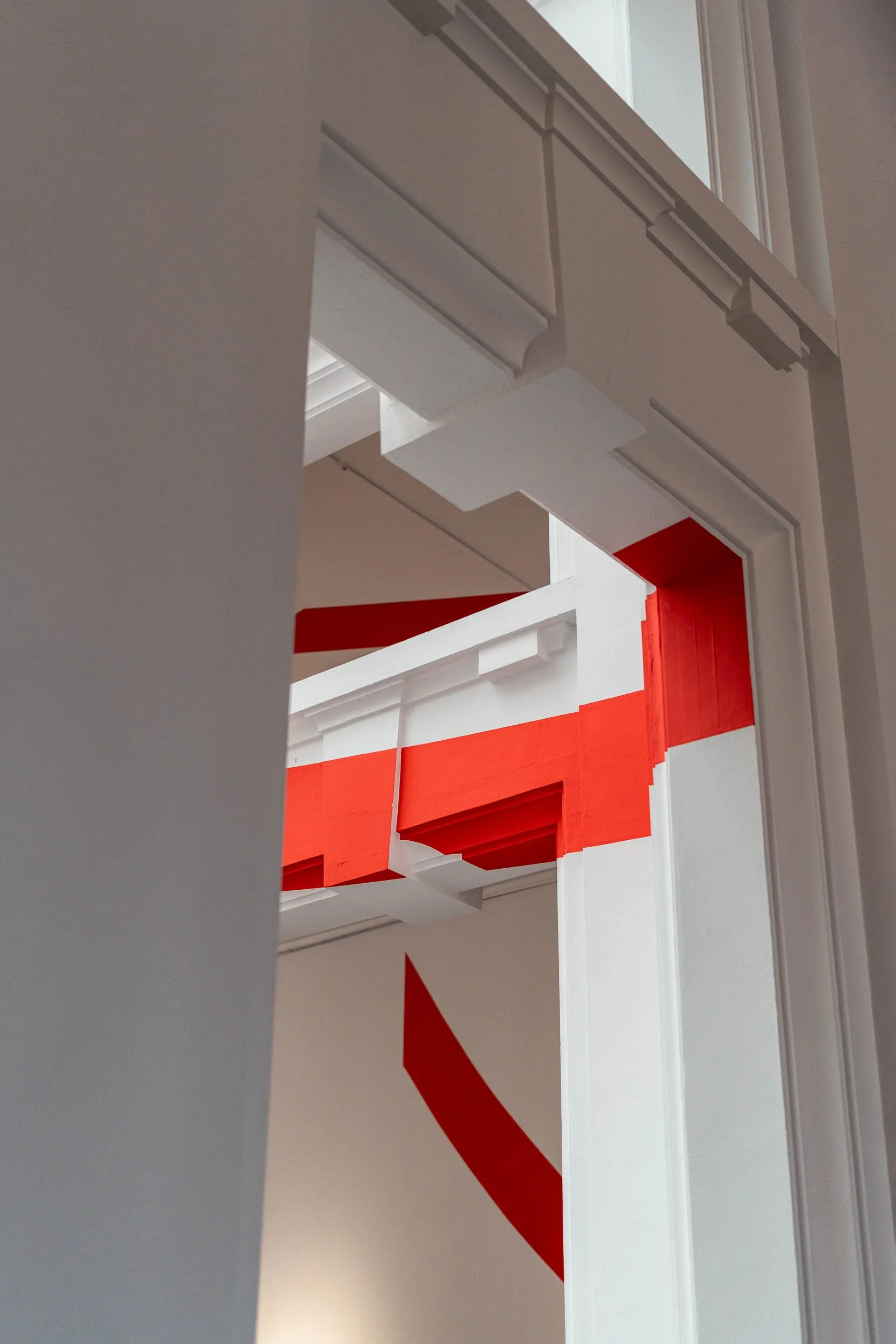
Trois cercles concentriques pour l’Atrium – Red Rings in the Sky
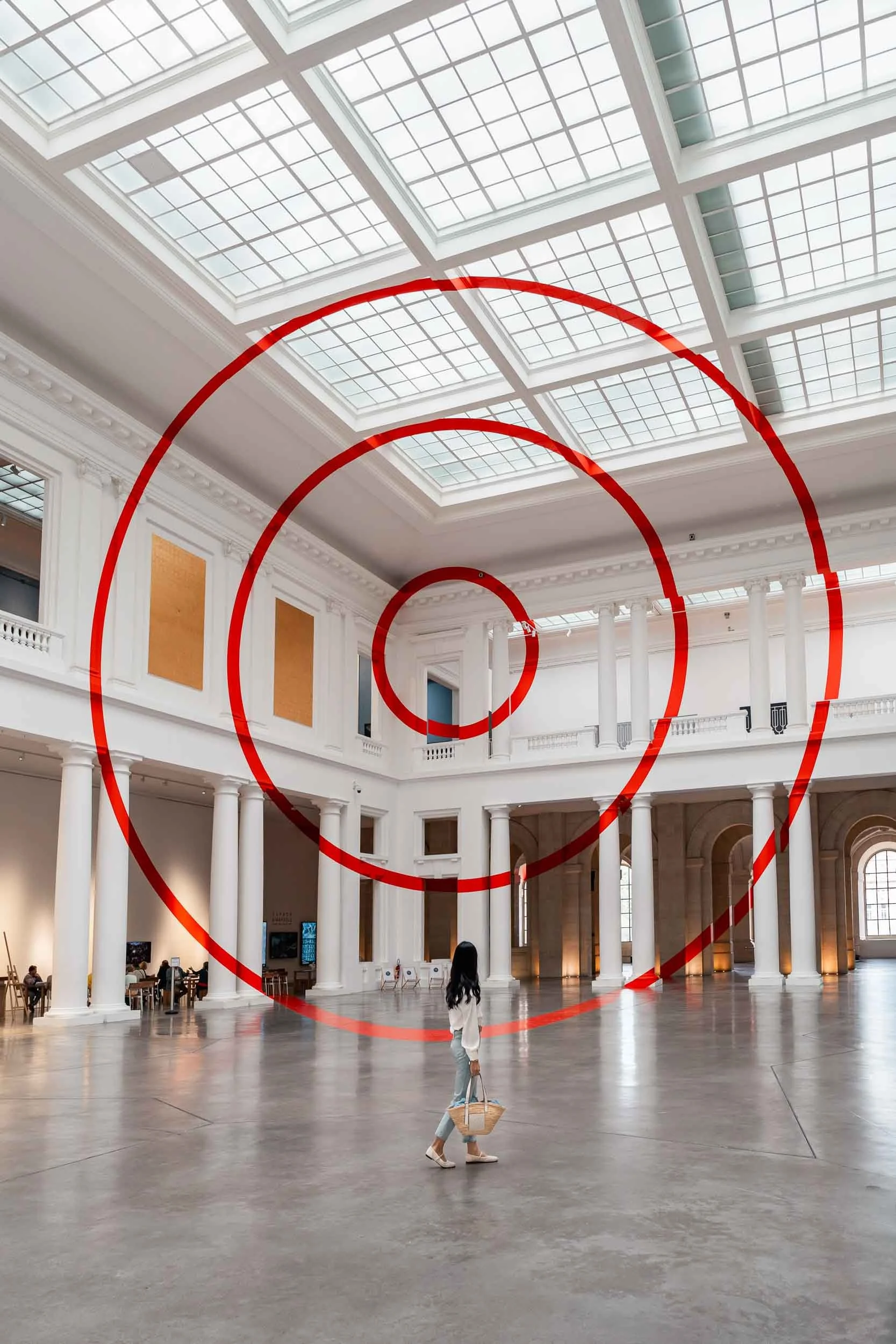
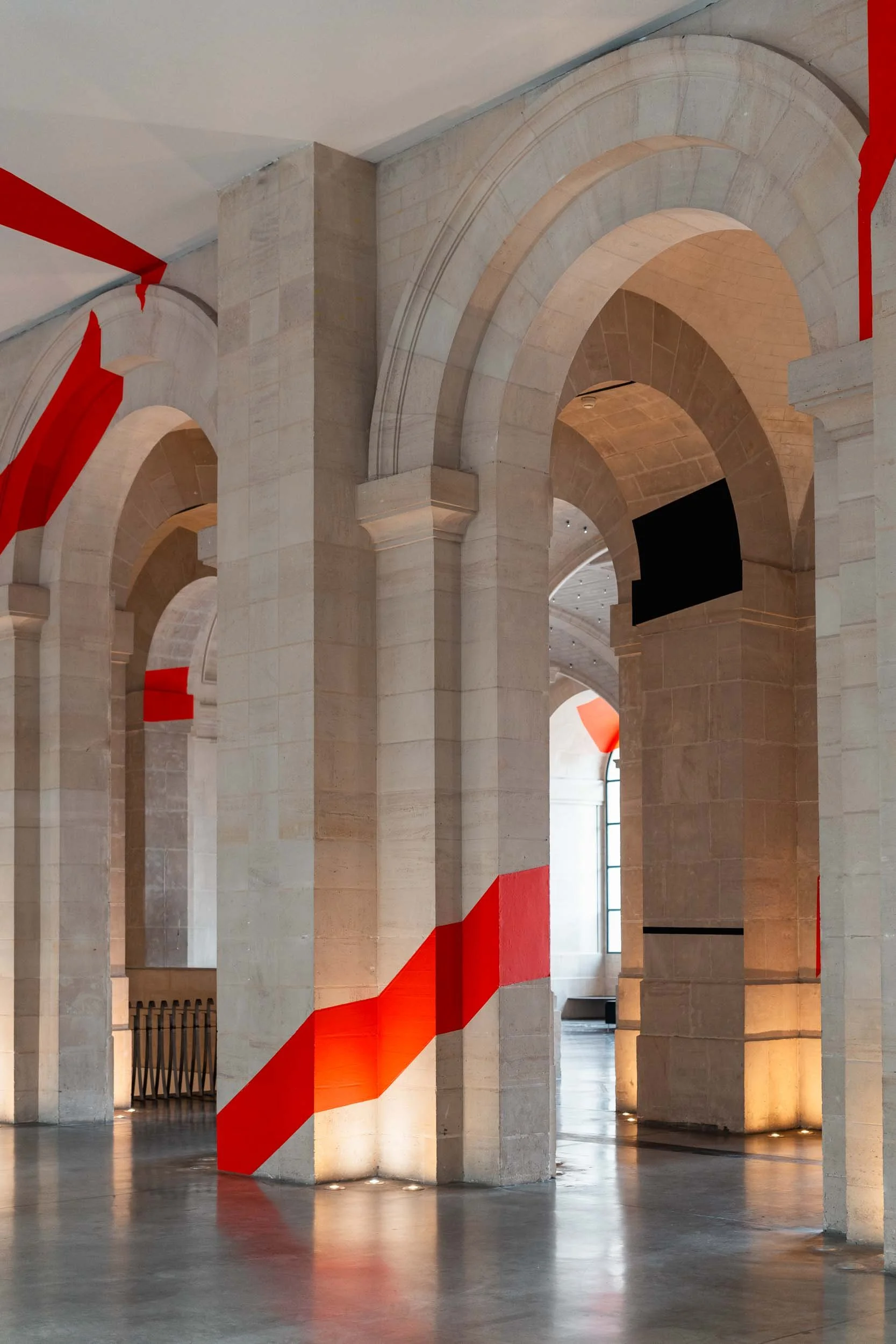
The atrium is the museum’s stage, and Varini has claimed it. Trois cercles concentriques pour l’Atrium (Three concentric circles for the atrium) is a series of flaming red circles that seem to float in mid-air, slicing cleanly through white columns and across the glass ceiling.
From most angles, they’re just abstract arcs sneaking around the room. But find the marked viewpoint, and the chaos tightens into three perfect concentric circles hovering in space, as if a graphic logo has crash‑landed inside a neoclassical temple.
The colour palette is gloriously minimal: pure, almost lacquered red against the chalky whites and soft greys of the atrium. It’s Instagram catnip, yes, but in person, the effect is more cinematic than cutesy. Standing in the centre, I felt like I’d walked onto the set of some arthouse sci‑fi film about time portals and French municipal funding.
What I love is how the work doesn’t fight the building – it frames it. The circles emphasise the rhythm of the columns and the height of the space, pulling your eyes upwards to that luminous glass roof. It turns an already impressive hall into a kind of spatial target, with you – lucky you – in the crosshairs.
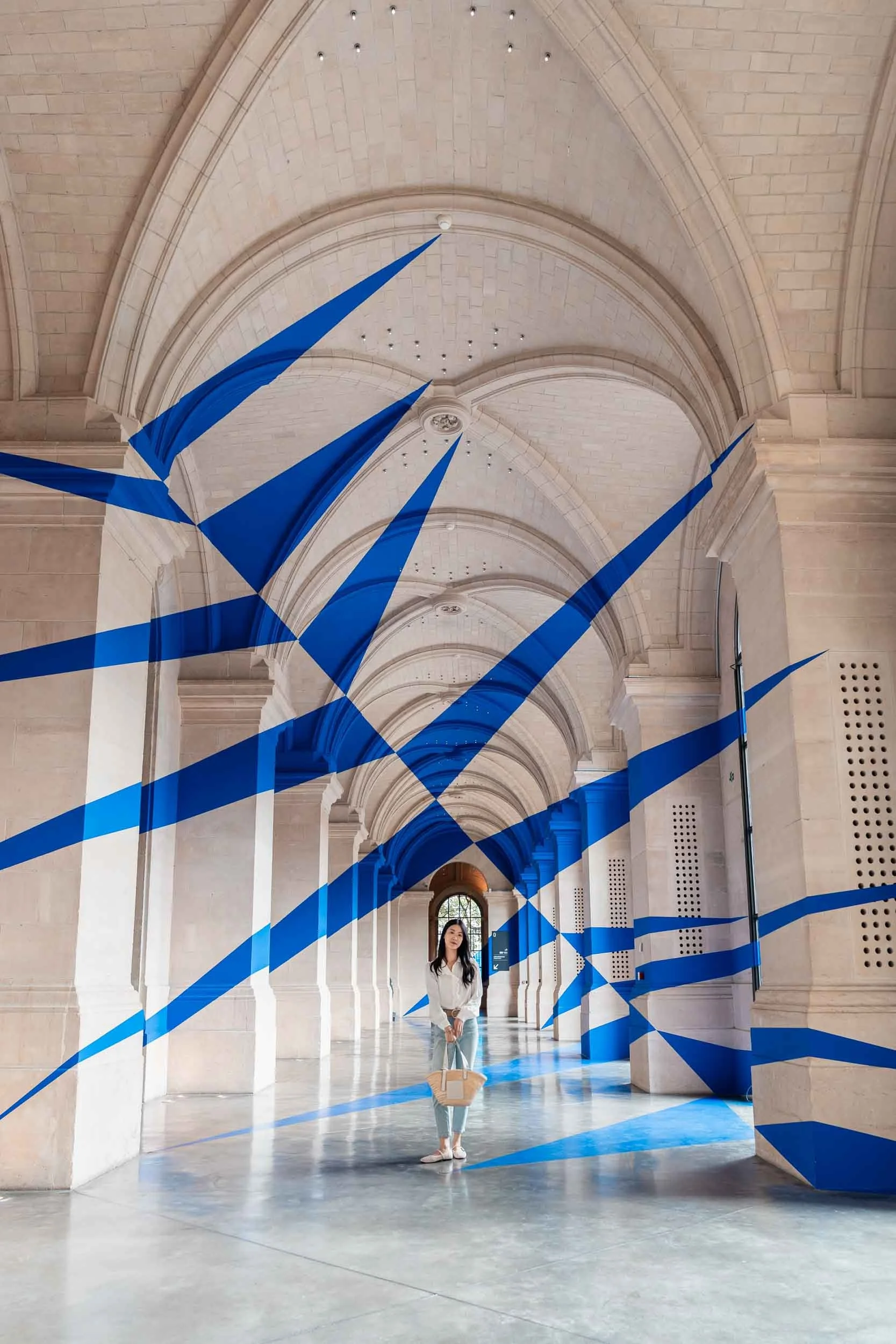
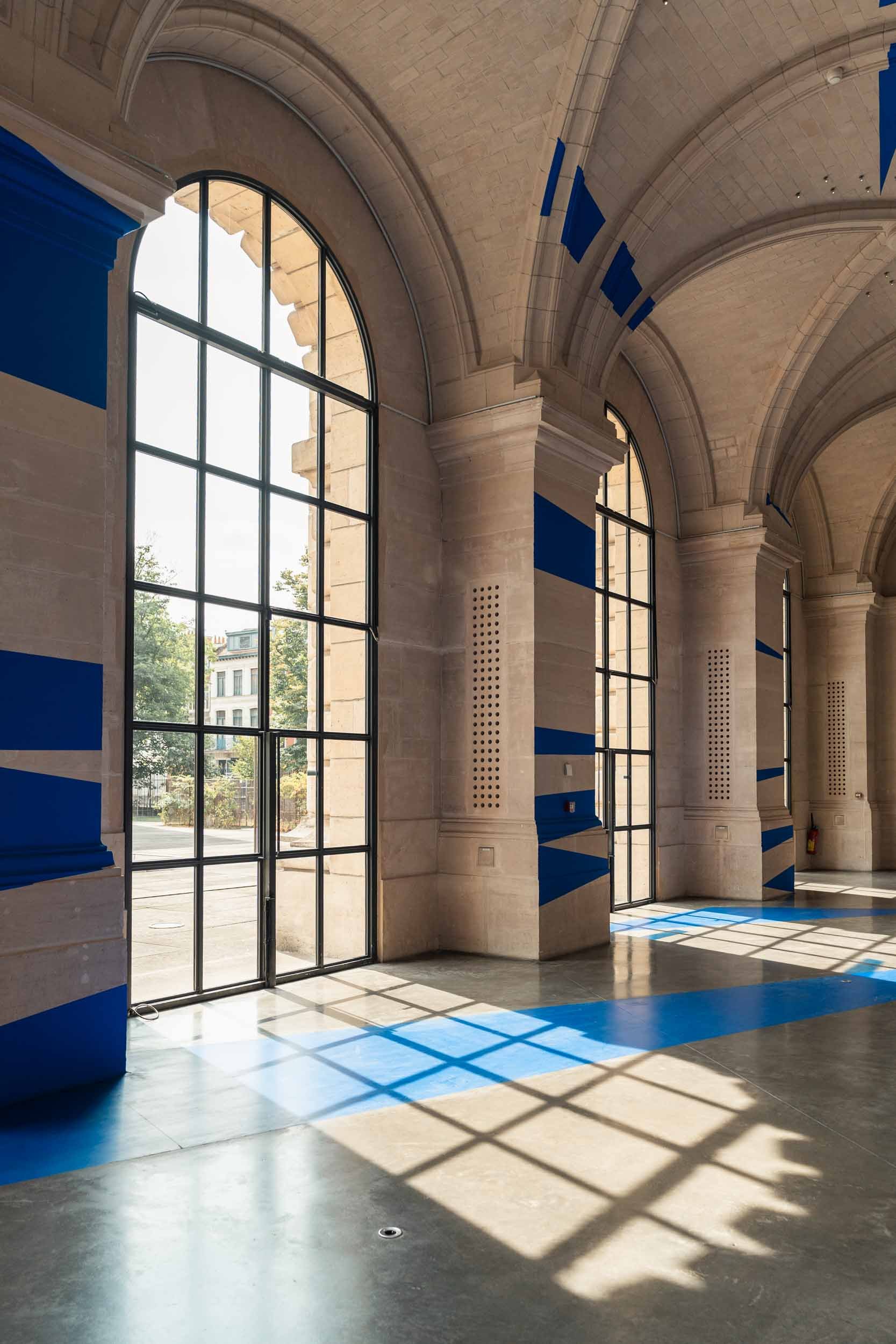
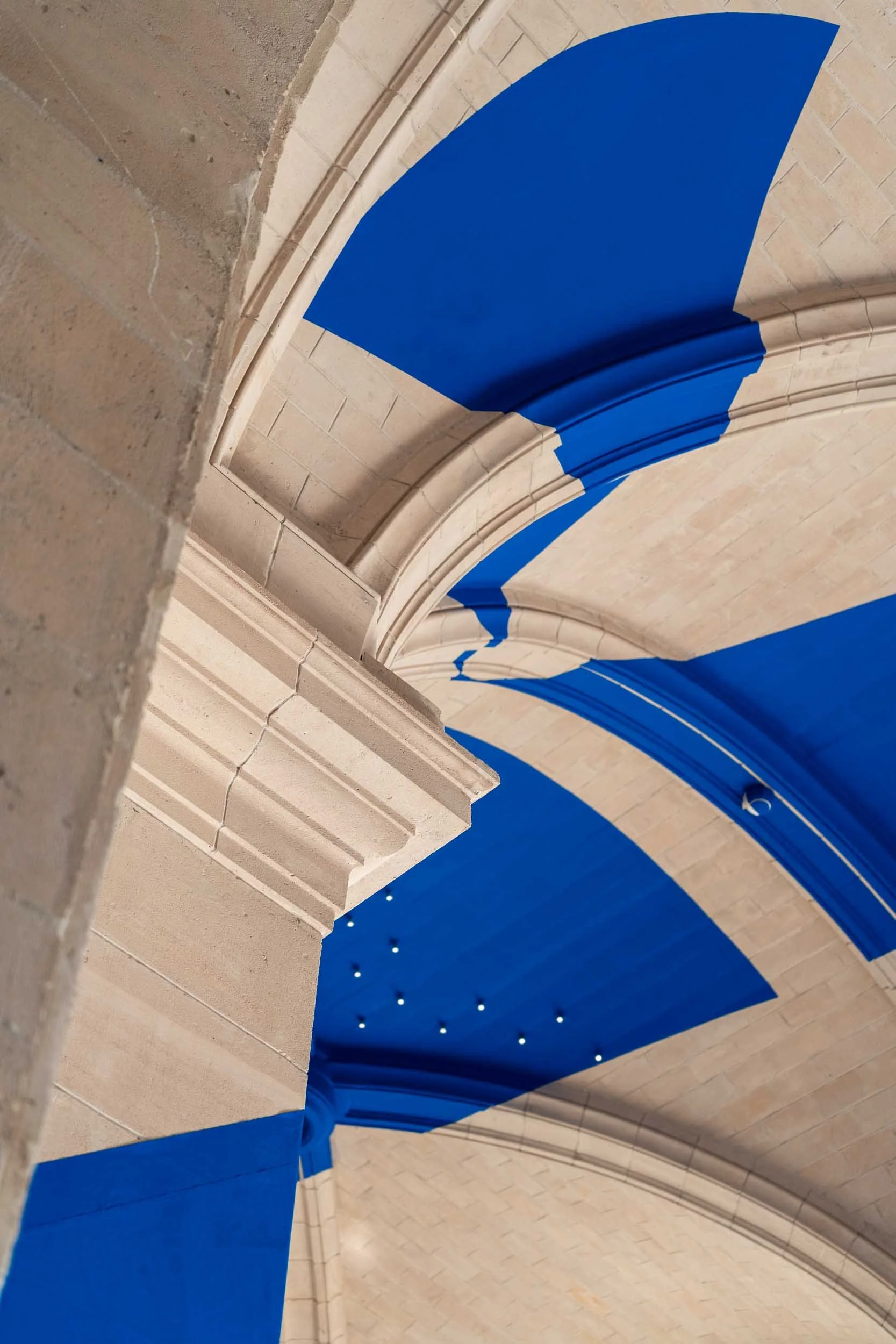
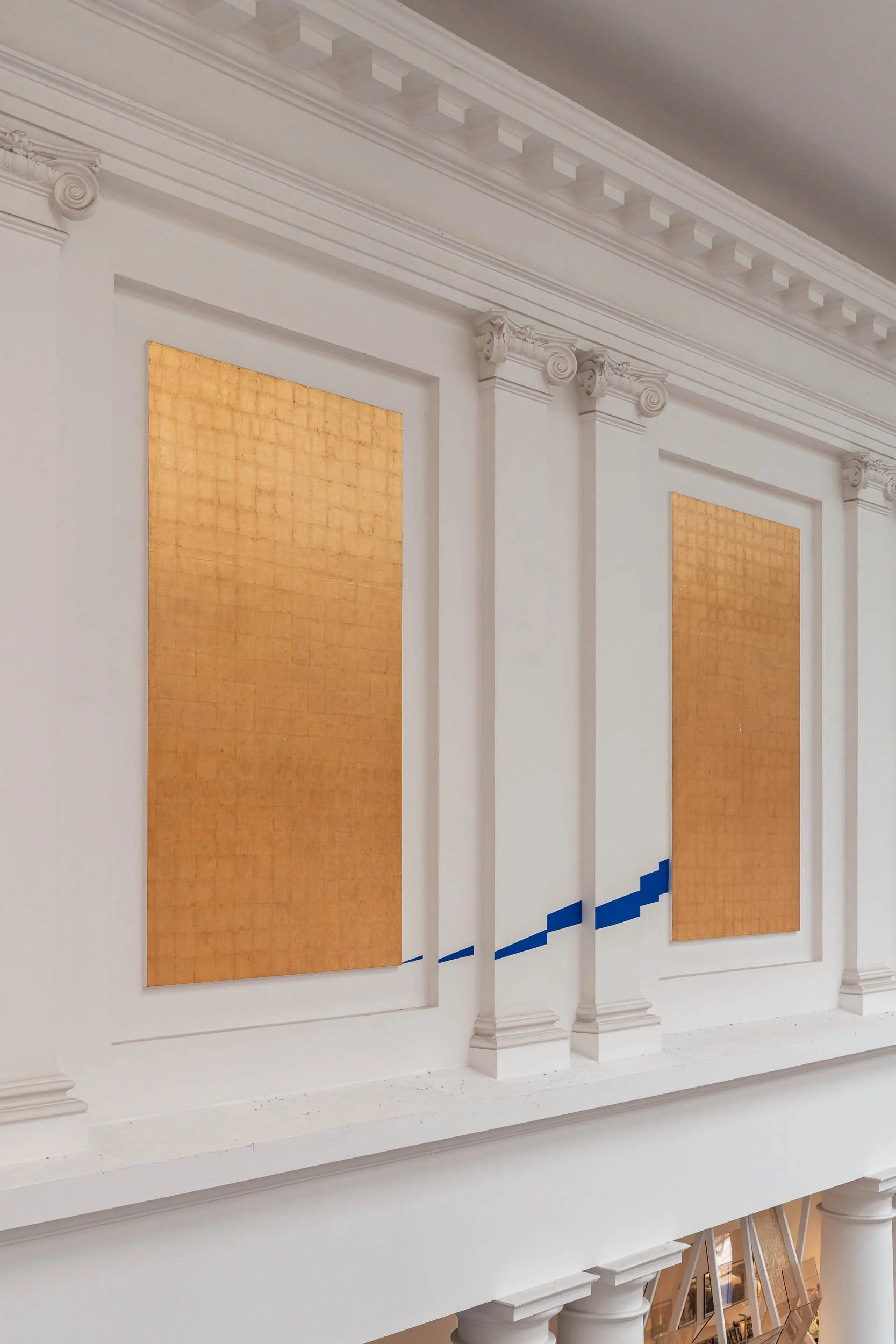
Diagonale aux dix-sept triangles – Blue Lightning in the Corridors
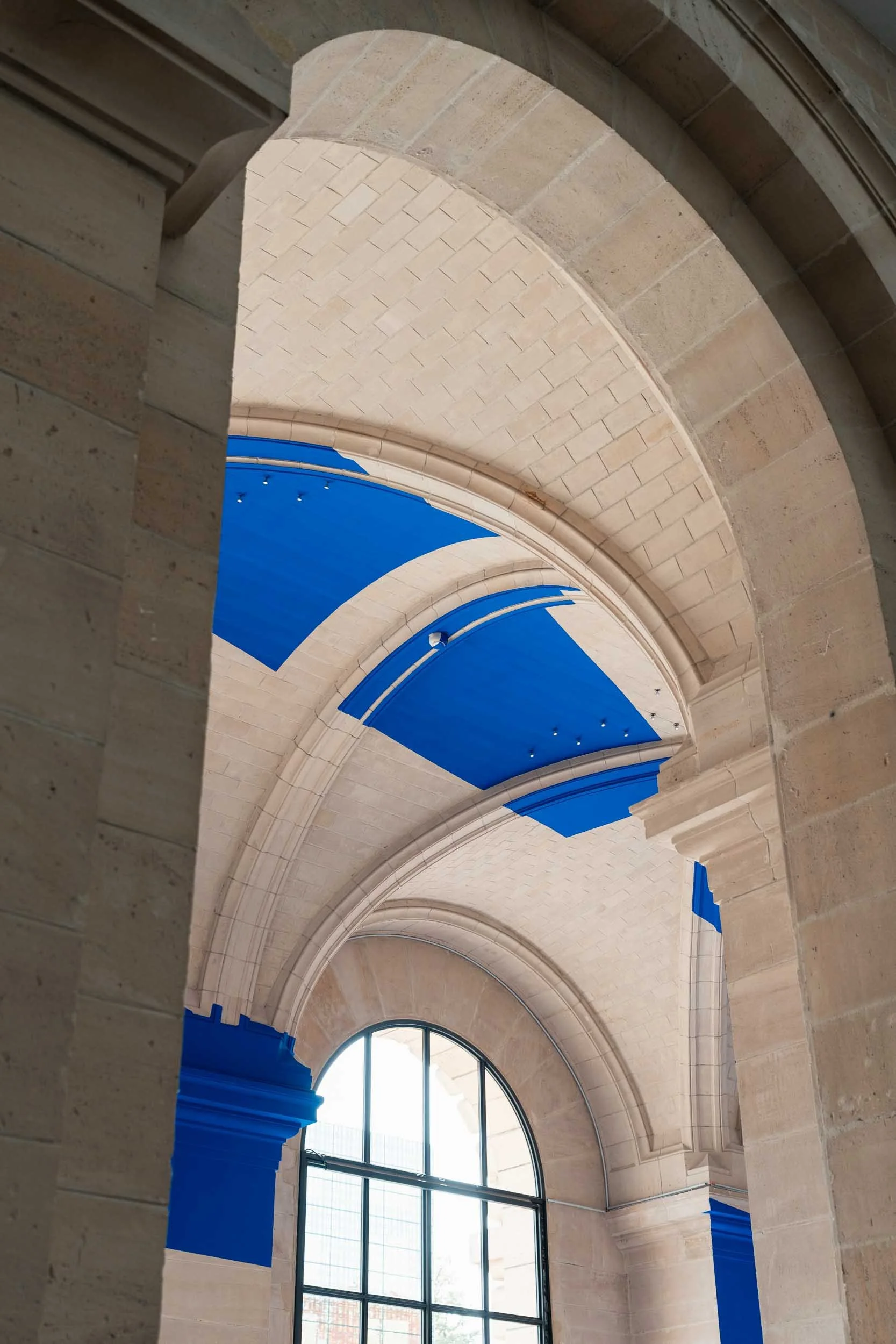
Move into the vaulted passageways, and the mood shifts. Diagonale aux dix-sept triangles (Diagonal to the seventeen triangles) slices through the stone arcades in a saturated, almost Mediterranean ultramarine blue.
Individually, the pieces are slanting blocks and spikes of colour – some wrapping around columns, others streaking across the floor. Step into the right spot, though, and they lock into a fierce zigzagging diagonal of seventeen triangles, racing down the length of the corridor like a bolt of cobalt lightning.
The cool blue is delicious against the warm limestone; it sharpens every curve of the arches and exaggerates the sense of depth. Walking through it, I felt as if the museum had suddenly acquired motion – the geometry pulls you onwards, almost like a moving walkway of colour.
It’s also quietly playful. You can see where the paint has had to hug awkward corners, where the triangles jump gleefully from pillar to wall to floor. It’s Varini’s recurring motif of sliced planes and sharp diagonals, but here it becomes a kind of architectural choreography. You’re not just viewing the corridor; you’re being choreographed through it.
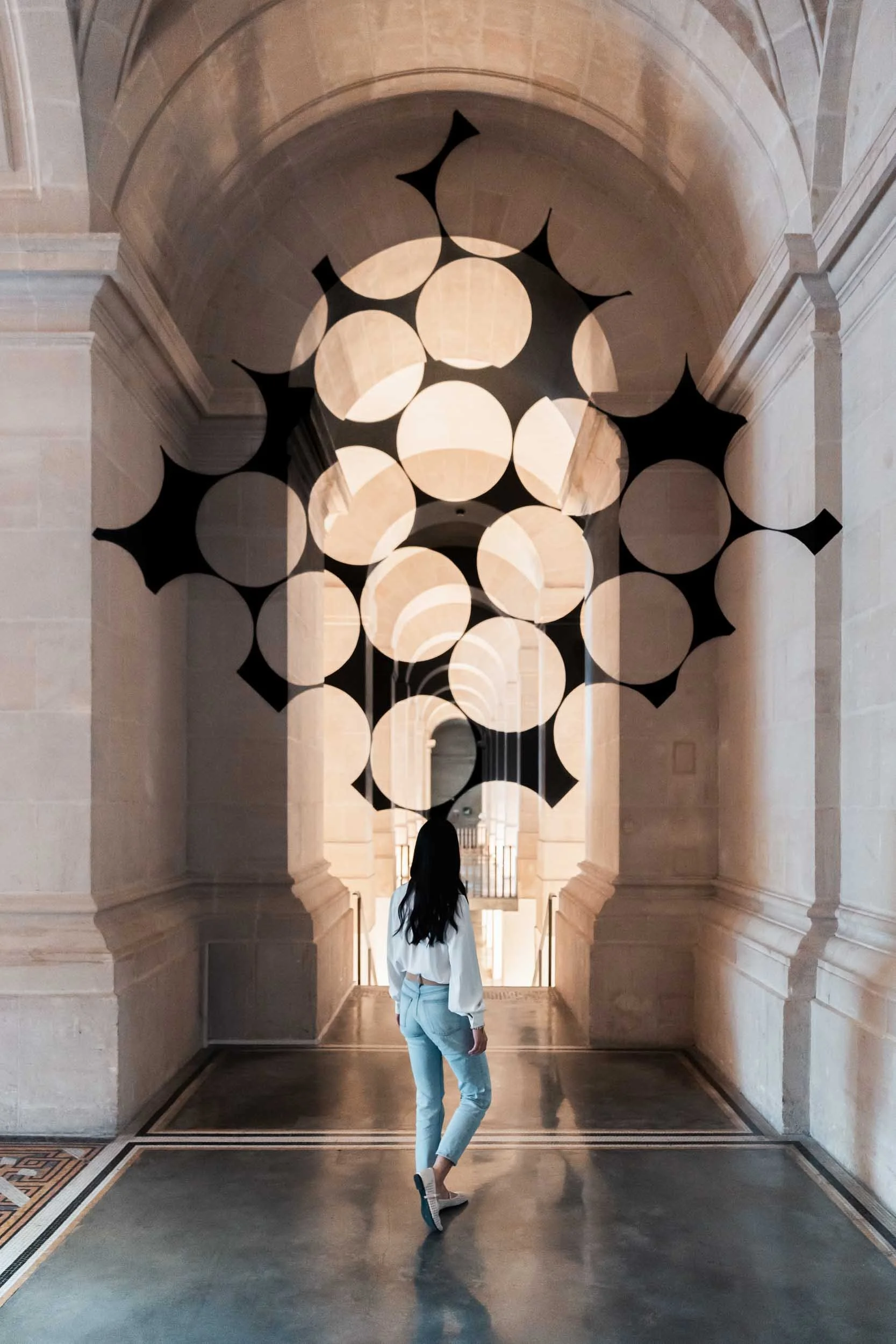
Disques dans le carré – Black Constellations in Stone
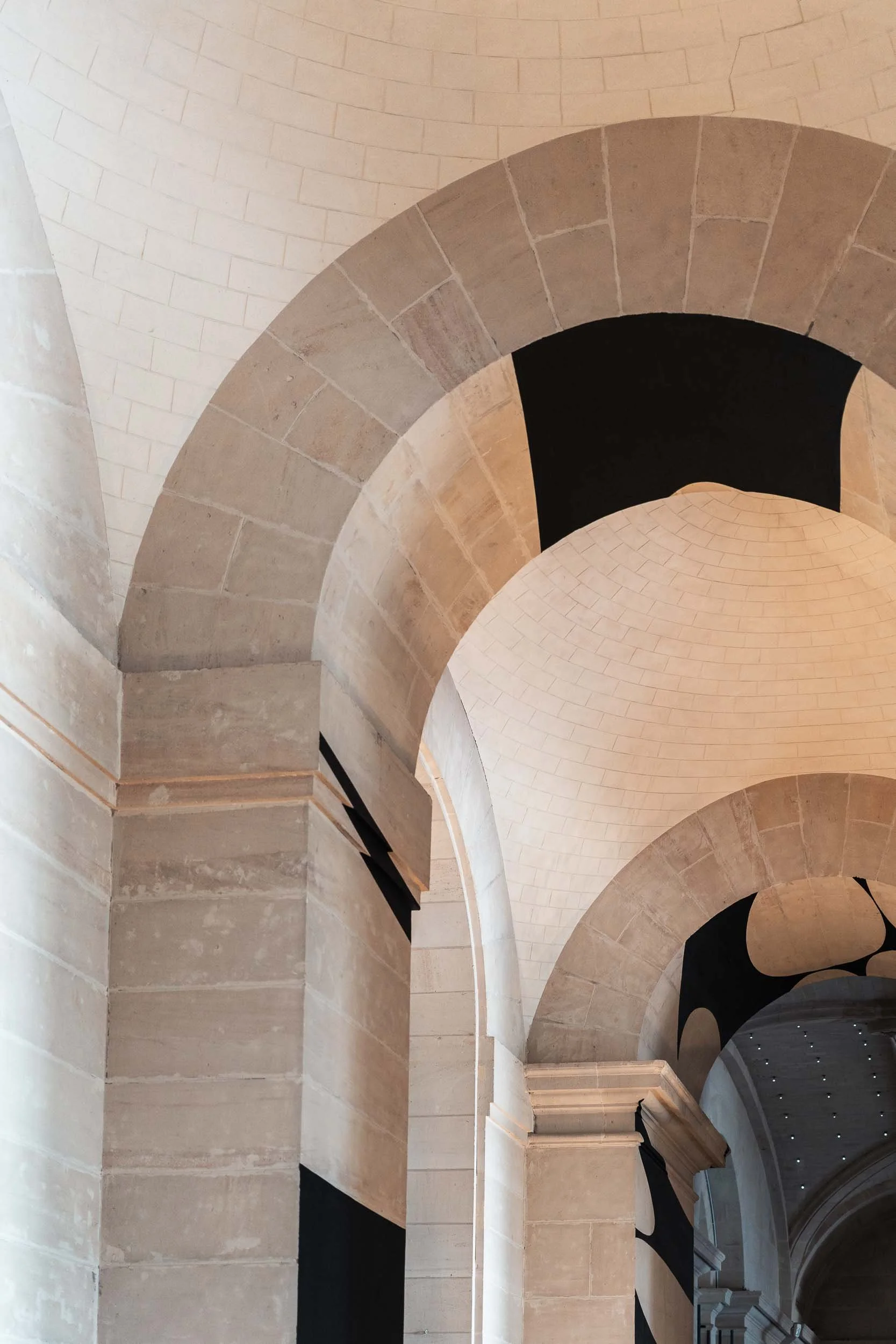
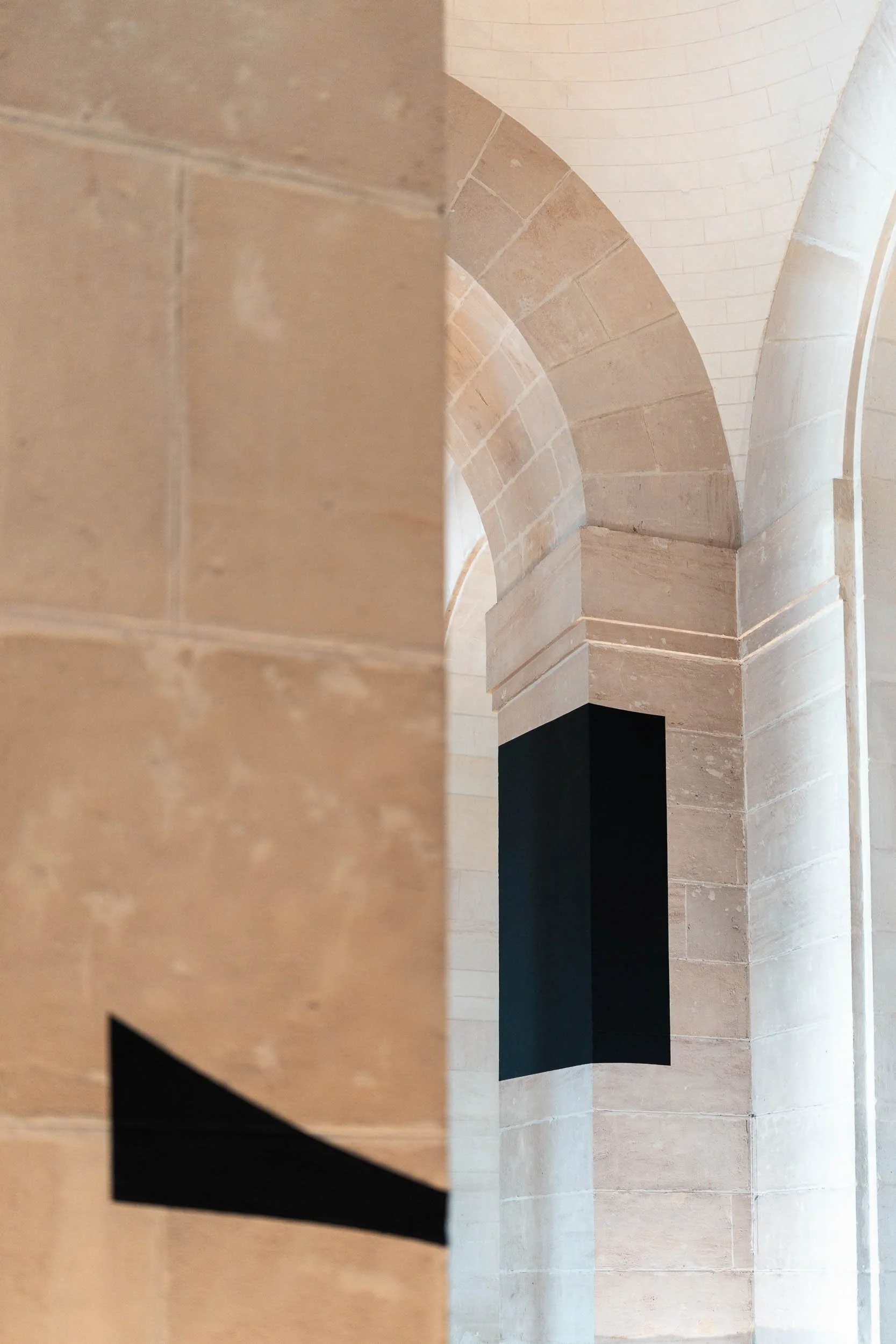
For me, the most mysterious of the three was Disques dans le carré (Discs in the square). In a more intimate passage near a staircase, black forms hover against the stone – crescents, circles, negative shapes that seem to vibrate between solid and void.
From the right perspective, they condense into a precise constellation of black discs inscribed within a square that appears to float between the walls. The geometry is stricter here, almost severe: a monochrome palette of deep black against pale stone and the soft glow of light further down the corridor.
If the red atrium feels extroverted and the blue corridor feels kinetic, this black installation is deeply introspective. Standing in front of it, I had the sensation of looking at a diagram of some cosmic alignment, or an ultra‑minimal stained‑glass window stripped of colour.
The way it interacts with the existing arches is gorgeous. The discs partially eclipse the view ahead, so as you walk closer, the composition fractures again and the space beyond opens up. It’s like being allowed behind the curtain of the illusion: the work gently reminds you that perspective is everything and that certainty is always a bit of a construct.
Final Thoughts: A Museum That Lets You Wander Off the Grid
Echoes of the Past doesn’t just decorate the Museum of Fine Arts; it rewires how you read its architecture. I loved how unapologetically site-specific the experience is. The same red circles or blue triangles would be pleasant enough in a white-cube gallery, but here they’re in constant conversation with classical cornices, vaulted ceilings and the soft northern light. The museum, usually busy telling the story of other centuries, becomes the protagonist of its own little art drama.
On a very personal level, I found the exhibition oddly grounding. There’s something reassuring about watching chaos fall into order, even if only from one precarious little spot on the floor. You wander through halls splintered with colour, slightly confused, and then suddenly everything aligns. It feels like a visual metaphor for travel itself: disjointed impressions that eventually assemble into a memory that makes sense.
Did I visit the Museum of Fine Arts just for its permanent collection? Absolutely. But seeing it dressed in Varini’s geometry – red circles pulsing in the atrium, blue diagonals crackling through the corridors, black discs hovering like an eclipse – felt like borrowing a new pair of eyes for the afternoon. And honestly, once you’ve watched a historic museum bend itself around a few impossible shapes, it’s very hard to go back to plain white walls.
Related Posts

Three site-specific installations for the Museum of Fine Arts, each with its own personality. Optical illusions or a graphic designer's fever dream?